Hello.
We are Hanstep Korean Medicine Clinic, researching and treating ulcerative colitis and Crohn’s disease since 2007.
Today I want to walk through a case of Crohn’s disease.
A man in his thirties.
On July 6, 2025, he had a stomach cramp. He took medication for it and vomited everything back up.
Then on July 11, his stool came out black.
Black stool. What does that mean?
Black stool is blood in the stool.
It is stool with blood mixed into it.
When people hear “blood in the stool,” they usually picture red blood. But the color changes depending on where the bleeding is.
If the bleeding is near the exit — the anus, the rectum, the far end of the colon — the blood comes out red, as it is.
But if the bleeding is higher up — the esophagus, the stomach, the duodenum, the small intestine — the story is different.
As the blood travels down the long way through the gut, it is broken down by stomach acid, digestive enzymes and intestinal bacteria.
The iron in the hemoglobin oxidizes, and the blood turns black.
That is why the stool comes out sticky and black, like black bean sauce.
This is called melena, or tarry stool.
Stool black enough to look like this means the amount of bleeding is not small.
Of course, iron supplements, or eating a lot of seaweed or squid ink, can also turn stool black.
But if there is no such reason and black stool appears, it can be a signal of bleeding somewhere in the upper digestive tract, and you must go to a hospital.
So he went to an internal medicine clinic, and they told him it was blood in the stool and to go to the emergency room if it happened again.
On July 13 he passed black bloody stool again, so on the 14th he went to a proctology clinic. There was bleeding from the anus, and a colonoscopy was scheduled for the 15th.
But on the 14th, on his way home, the bleeding suddenly became so severe that he went to the emergency room.
They did a colonoscopy and found a large ulcer in the colon, which they clipped. On the 17th the bleeding returned, severely.
The ulcer in the colon had been clipped and he was still bleeding heavily, so they suspected bleeding in the small intestine.
On the 18th a capsule endoscopy showed severe bleeding in the small bowel, and on the 19th he was diagnosed with Crohn’s disease.
He was prescribed a steroid and a 5-ASA preparation.
He came to Hanstep Korean Medicine Clinic on July 23, 2025.
With the steroid, at least the bleeding had stopped.
He is 173 cm tall and weighed 48 kg.
A BMI of only 16.03. Extremely underweight.
From his first episode of black stool on July 11 to the Crohn’s diagnosis took exactly eight days.
And he bled throughout that period.
This man had been carrying inflammation from Crohn’s disease in his gut all along.
He simply had not known it.
Then it suddenly worsened, and things unfolded the way they did.
The inflammation in his colon was severe, and the inflammation and bleeding on the small-bowel capsule endoscopy were extremely severe as well.
The gastroscopy also showed significant reflux esophagitis.
Let’s look at the images.
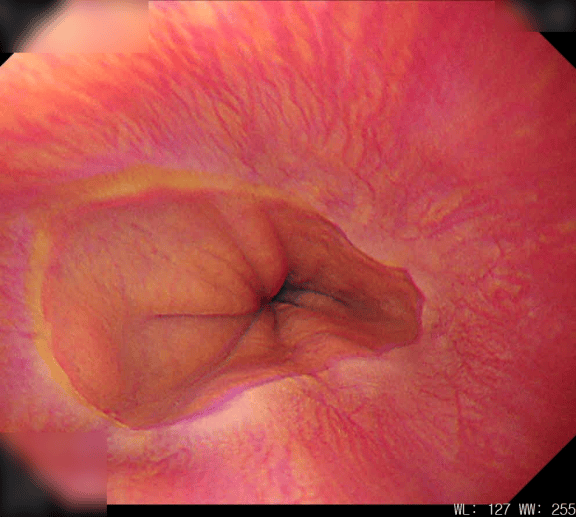
This is the cardia, where the esophagus meets the stomach. You can see the rim standing out sharply. That is inflammation from reflux esophagitis.
And this is the colonoscopy.
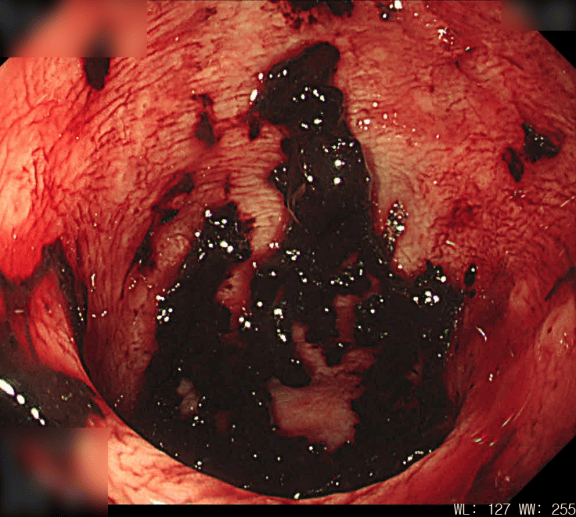
You can see the sticky black melena — the tarry stool — right away.
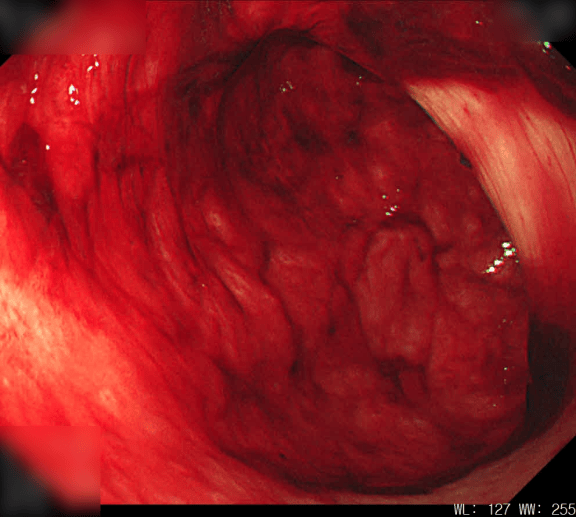
The entire bowel wall is red and congested. It looks like a scene from a horror film.
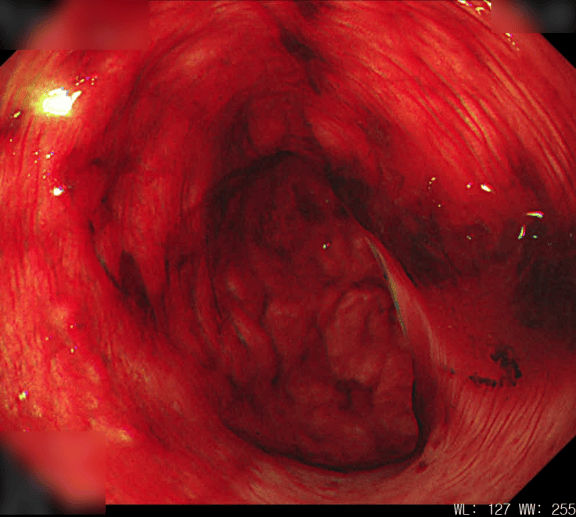
Black stool and a congested bowel wall here as well.
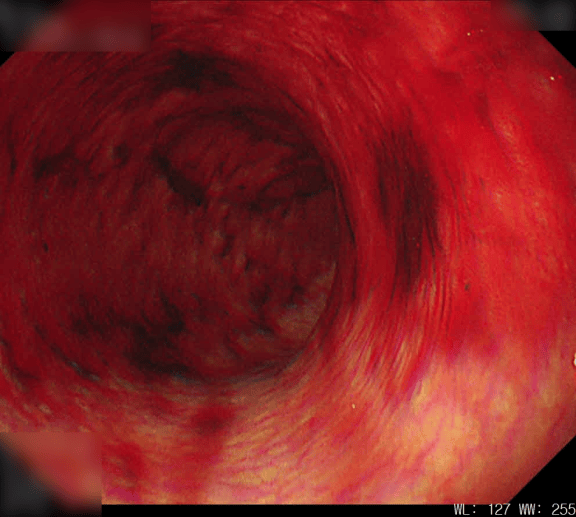
Severe congestion here too.
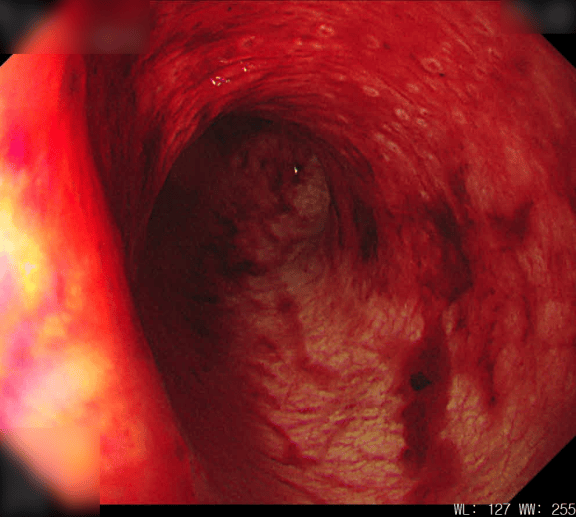
Severe congestion here as well. It is quite bad.
Now here is the small-bowel capsule endoscopy.
With a colonoscopy the scope goes in and inflates the bowel with gas, but the capsule simply travels through.
So it looks like you are watching underwater.
There is far too much footage to show all of it.
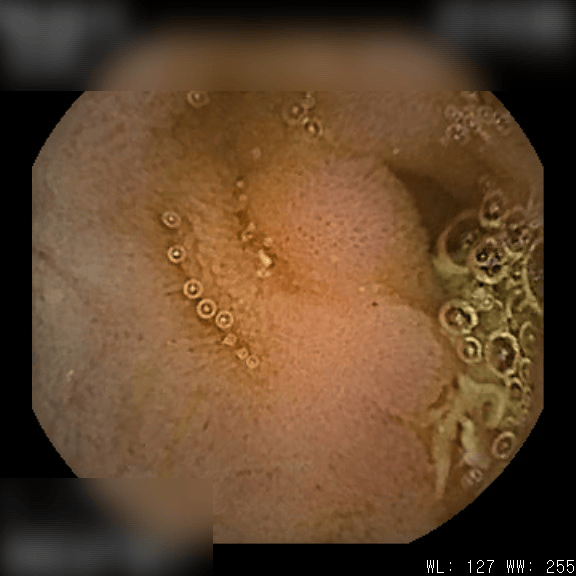
You can see patches of mild congestion and inflammation in places like this.
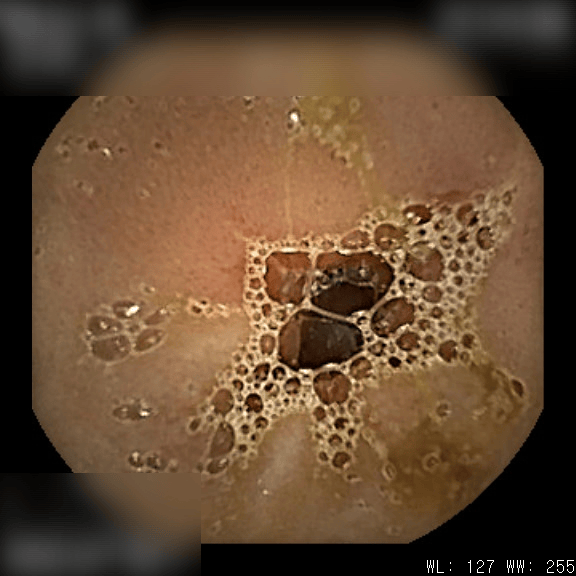
And here.
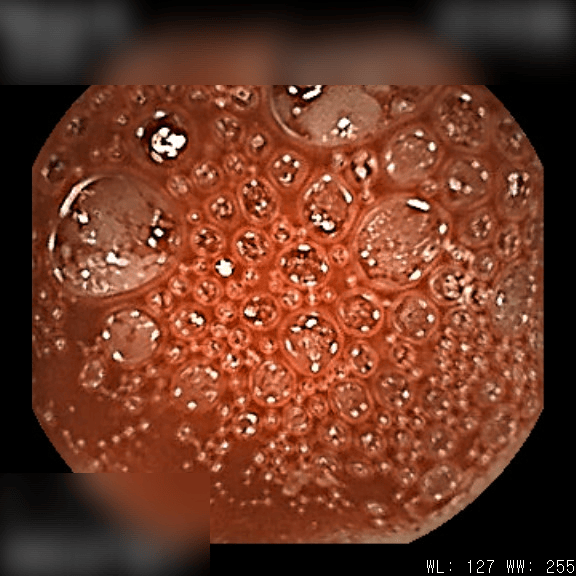
Then suddenly a bleeding segment appears. The whole field is full of blood.
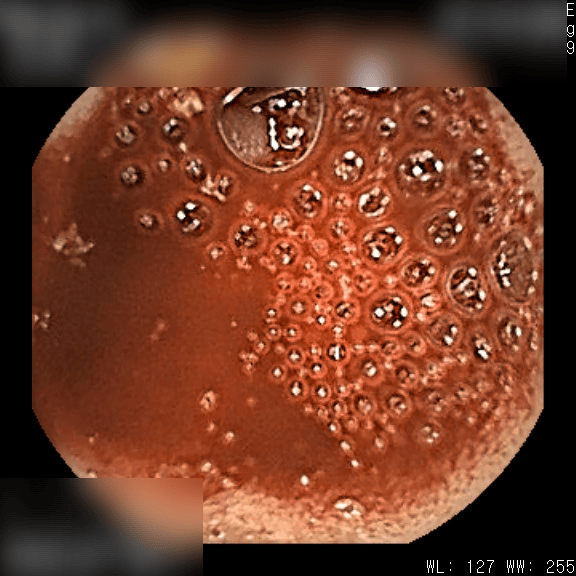
Bleeding here as well.
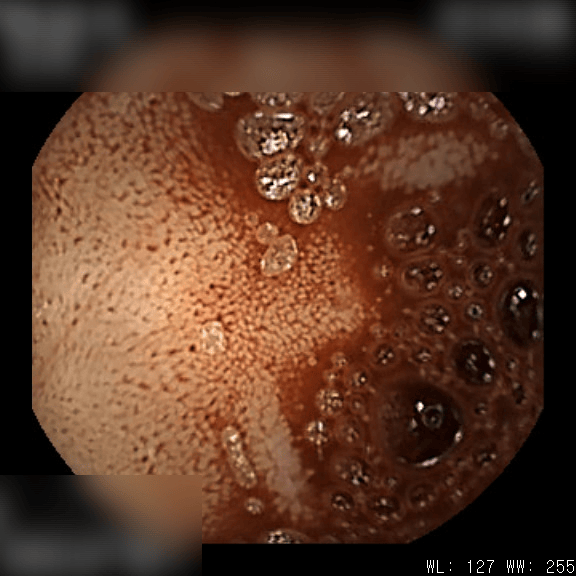
Blood pooling here.
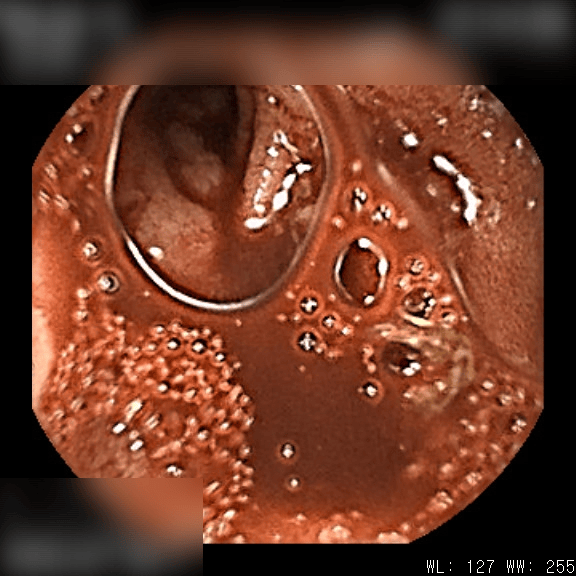
Heavy pooling of blood here.
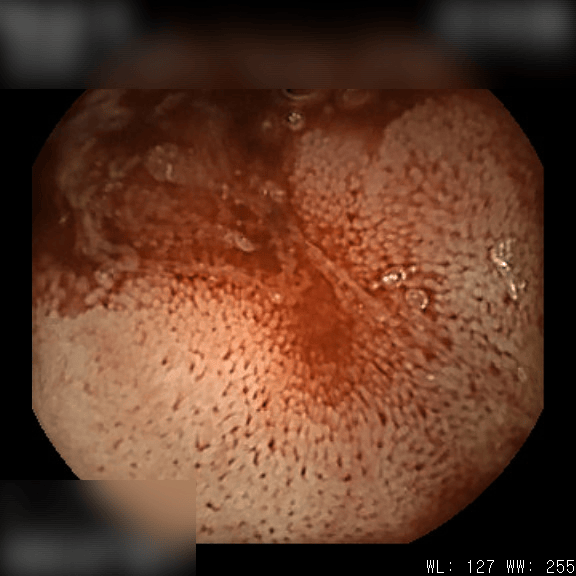
Still bleeding here.
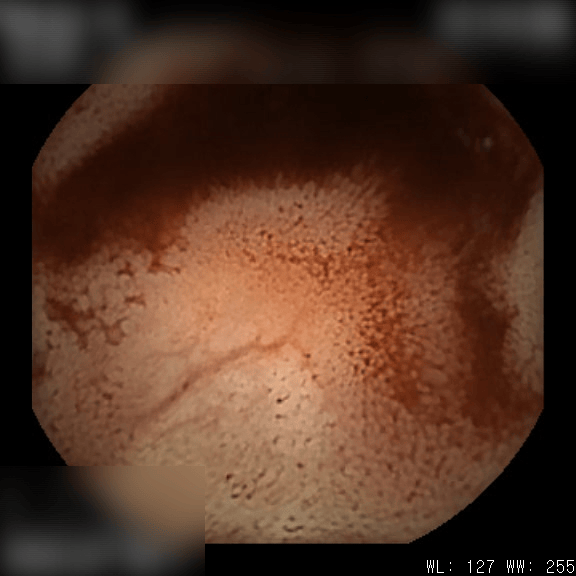
A lot of blood here too.
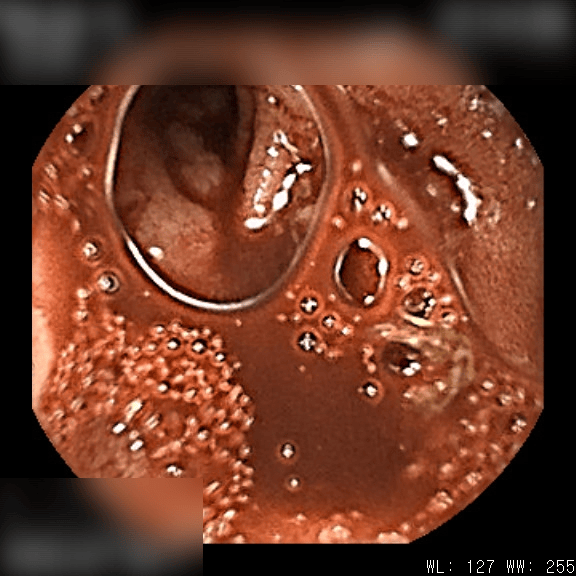
This is how much blood was coming from the small intestine. That is what produced the black stool we saw in the colon.
Those were the gastroscopy, colonoscopy and capsule endoscopy images.
Now let’s look at his condition when he came to us.
Bowel movements once a day, normal stool. After starting the steroid, the bleeding had stopped.
Some mucus in the stool, and an occasional sense of incomplete evacuation.
His appetite was decent, but meat and wheat did not digest well.
Under stress his digestion suffered badly, and if he ate on a stressful day he always got indigestion.
Acid reflux. After meals, always a sloshing sound in his abdomen. Frequent belching.
Gas more than ten times a day. Cold food gave him diarrhea. His abdomen ran cold as a rule, and his hands and feet were cold.
He also had rhinitis — sneezing and a runny nose from dust, and sneezing when he looked at sunlight.
As a child he had severe atopic dermatitis.
Upper digestive problems stand out very clearly, and there are respiratory problems alongside them.
And with bleeding in both the small and large intestine, there is obviously an inflammatory problem as well.
This is the textbook case of what I always describe: multiple causes in one patient.
So you work through them in order.
We started with the upper-digestive prescription.

July 28. Fecal calprotectin 59. Fecal occult blood 99 — negative.
He was on a steroid, so the numbers were relatively stable.
But a steroid is not a drug you can stay on forever.
The hospital began tapering it.
In early August he went from four tablets a day down to three, and they added a 5-ASA preparation.
The steroid was bringing out a lot of acne, which worried him a great deal.
August 11. No blood and no mucus in the stool.
The sloshing sound in his abdomen after every meal was gone.
Cold food no longer gave him diarrhea.
And on August 29, 2025, he stopped the steroid completely.
Here is something important.
Crohn’s disease — especially Crohn’s with small-bowel bleeding — usually flares again when the steroid is withdrawn.
A steroid suppresses inflammation forcefully. While you are taking it things improve, but when you stop, the inflammation that was being held down comes back up.
So patients taper, flare, go back up, taper again, flare again. A great many people cycle like this.
But this man did not worsen after stopping.
September 5. Normal stool, no blood.
The indigestion he used to get under stress was more than 90% better.

September 24. Fecal calprotectin 59.
Nearly a month after stopping the steroid, and the number is exactly the same as when he was on it.
In other words, there was no deterioration.
The herbal medicine had taken the steroid’s place.
With the digestive problems largely settled, at the end of September I switched him to the respiratory-type prescription.
October 14. The morning congestion and runny nose were about 80% better.
The sneezing and runny nose after a shower were gone.
The tightness in his chest under stress was gone too.

But on October 27, fecal calprotectin came back at 138.
The number had risen.
With the respiratory problem settled, the inflammatory problem was now surfacing.
So at the end of October I switched him to the inflammatory-type prescription.
Then, from November 10, his stool began to darken, and on November 12 and 14 he passed black diarrhea.
A home occult blood test came back positive.
The bleeding had returned, just as when he was first diagnosed with Crohn’s disease.
What is usually done at this point? You restart the steroid, or move to an immunosuppressant or a biologic.
But I changed the herbal prescription instead.
Still an inflammatory-type prescription, but I moved him straight to the next one in the sequence.
And on November 28, after the change, the black diarrhea was gone.
No blood, one normal stool a day.
His appetite improved so much that he was eating one and a half portions.
His hemoglobin was 9.3. On December 2, 9.6. On December 24, 10.2 — recovering step by step.

And on December 19: fecal calprotectin 9.1. Fecal occult blood 31 — negative.
From 138 down to 9.1.
The small-bowel bleeding had returned, and it settled again with no steroid — simply by changing the herbal prescription.
This is the most important moment in today’s case.
With the numbers stable, we began reducing the 5-ASA, and from January 7, 2026, he stopped that as well.
From this point he takes no Western medication at all.

January 21, 2026. Fecal calprotectin 18.0.
The steroid was gone, the 5-ASA was gone, and the inflammation number kept falling. This is the part I want you to look at carefully. Most people assume that when you take away the drugs, the disease comes back. Here it did the opposite.

February 23, 2026. Fecal calprotectin below 3.8 — under the limit of detection.
In mid-March he noticed more belching after meals and a little phlegm in the mornings, so I added the respiratory-type prescription alongside what he was already taking. By March 27 the belching was down about 70 percent and the phlegm about 70 percent as well.

April 20, 2026. Fecal calprotectin 13. Fecal occult blood 9 — negative.
July 1, 2026. One normal bowel movement a day. No blood, no mucus.
His weight is back up to 48–49 kg.
It has now been more than half a year since he stopped every Western drug. The steroid he stopped in August 2025, so he has been off it for over a year.
And through all of that the calprotectin has stayed normal and the occult blood has stayed negative.
A man who ended up in an emergency room with severe bleeding in his small intestine has held steady this long without a single Western medication.
So I have asked him to repeat the colonoscopy, and the small-bowel capsule endoscopy along with it.
The first capsule study showed severe bleeding in the small intestine, so we need to see with our own eyes what it looks like now.
When the results come in, I will show you those too.
There are a few things I want to say about this case.
First. Crohn’s disease with small-bowel bleeding can also stabilize after the steroid is stopped.
The fact that he did not deteriorate after stopping the steroid means the herbal medicine was suppressing the inflammation completely, in the steroid’s place.
What makes herbal medicine different from a steroid is that there are no side effects like Cushing’s syndrome at all.
And once the patient has been treated, stopping the herbal medicine does not bring the disease back.
Second. Even if bleeding returns in the middle of treatment, there is no need to panic.
This man passed black diarrhea in November and became anemic, but when I changed the prescription he stabilized again.
Changing the prescription to match the cause — that is the key.
Third. It is possible to stay stable for a long time with every Western drug stopped.
He has kept his calprotectin normal for more than half a year without any Western medication.
There is one more thing I want to say.
Not long ago a patient with Crohn’s disease and bleeding in the small intestine contacted me after watching my YouTube channel.
In the end he could not bring himself to trust Korean medicine treatment, and he never came in.
I understand completely.
Bleeding from the small intestine is a frightening thing.
But I would like you to think about this for a moment.
Up to now I have shown you case after case of patients with ulcerative colitis and Crohn’s disease who had bleeding in the colon, who were treated with herbal medicine, and whose bleeding stopped.
I confirmed it by endoscopy, by calprotectin, and by occult blood testing.
If bleeding in the colon can be stopped, shouldn’t bleeding in the small intestine be treatable too?
The colon and the small intestine are the same gut.
The way inflammation arises and the way bleeding arises are no different.
The man I showed you today is the proof.
That is all for today.
Thank you.
If you have questions about Crohn’s disease or ulcerative colitis, bleeding in the small intestine, black stool, or tapering steroids, please leave a comment. I read them and take them up as topics.
▶️ Watch our YouTube video on this case:
https://youtu.be/WfblkfOsikQ
Please turn on subtitles to watch.
HanStep Korean Medicine Clinic – Inflammatory Bowel Disease Clinic
https://hanstep.co.kr/en/


Leave a comment