Hello.
We are Hanstep Korean Medicine Clinic, researching and treating ulcerative colitis since 2007.
Today I want to walk through a case of ulcerative colitis in a man in his thirties.
In August 2024 he began passing blood and having diarrhea.
A colonoscopy in September raised the suspicion of ulcerative colitis, so he went to a specialist hospital, where the diagnosis was confirmed.
He took Western medication for about three months, and the blood and mucus in his stool disappeared.
Let’s look at the colonoscopy images from September 2024.
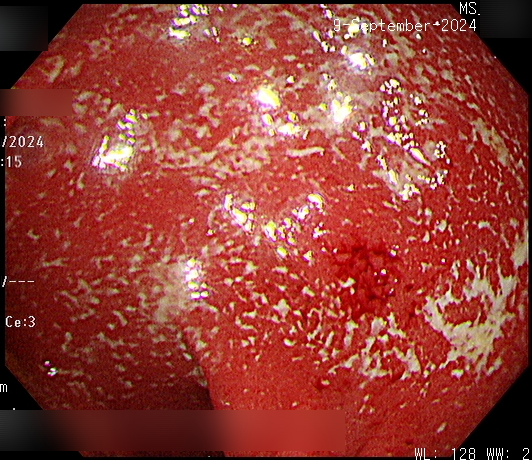
Most of the inflammation is in the rectum.
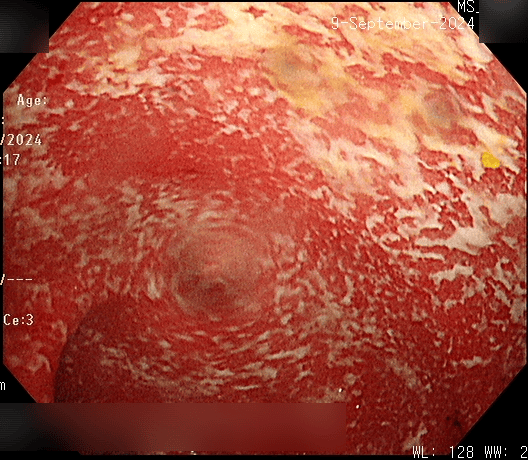
Even at a glance you can see how much white exudate is packed onto the bowel wall.
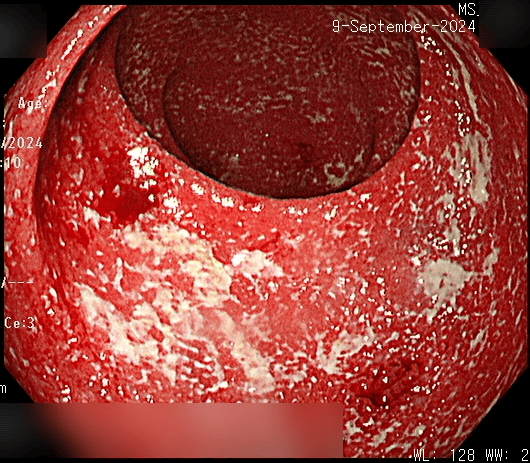
White exudate here too, along with a great deal of bleeding.
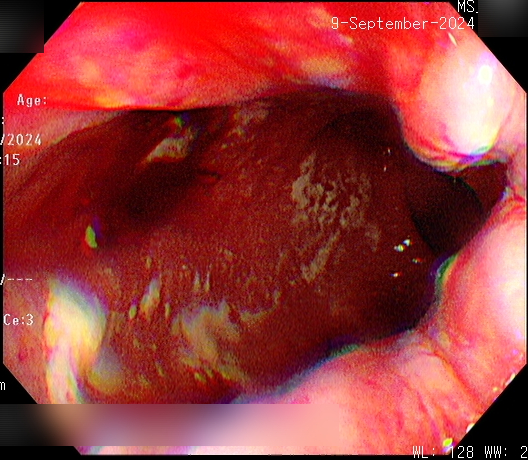
This area is in bad shape as well.
He came to Hanstep Korean Medicine Clinic in March 2025.
At that point the only Western medication he was taking was mesalazine, three tablets a day.
When I examined him:
Bowel movements twice a day, normal stool.
No blood, no mucus.
Digestion was not a problem.
His abdomen felt a little cold.
A lot of spicy food gave him some abdominal pain.
In short — from the outside, there were no real symptoms.
So I asked him: you have hardly any symptoms, why did you come?
He said he wanted to be completely cured of ulcerative colitis. That is why he came.
First, let’s run a stool test, I said.

March 12, 2025. Fecal calprotectin 717. Fecal occult blood positive at 243.
717 is high. Normal is under 50, or under 100 depending on the laboratory — so this is at least seven times the upper limit.
And although he had told me he saw no blood in his stool, the occult blood test came back positive. There was bleeding he simply could not see.
This man was, in fact, being very wise.
Most patients with ulcerative colitis assume that if there are no visible clinical symptoms, everything is fine. But inflammation can be present with no outward symptoms at all — that happens often.
In his case the stool inflammation marker was 717, more than seven times normal, and there was ongoing bleeding in the stool. The inflammation was still there.
If he had left it alone, taking only the Western medication — would it stay like this for life, or suddenly flare one day? No one can say.
But one thing is certain. Ulcerative colitis is not a disease you can expect to resolve on its own by chance. And if inflammation like this is left in place while taking only Western medication, then ten or twenty years later the risk of colorectal cancer rises to several times that of a healthy person.
Suppose this man, now in his thirties, develops colorectal cancer around his fifties. In Western medicine the operation would be to remove the entire colon. From his fifties until the end of his life he would live without a colon, with a stoma bag, with diarrhea six or ten times a day, for the rest of his life.
Many people who feel their disease is “controlled” by Western medication are in fact living with inflammation that has never fully disappeared. And in the end they carry that cancer risk.
I have previously shown a case of a patient who developed ulcerative colitis in his twenties and was diagnosed with colorectal cancer in his forties. That is how it happens.
So if Western treatment has not completely suppressed the inflammation, it deserves serious thought.
How does a patient with ulcerative colitis prevent colorectal cancer? By treating the inflammation completely. Once the inflammation that keeps recurring in the colon is gone, the rate of colorectal cancer becomes the same as in a healthy person. Then there is nothing much to worry about.
That is why this man was genuinely wise.
Remove the inflammation from the colon. We began treatment with that clear goal.
About ten days into treatment, he reported blood in his stool.
It turned out that the moment he started Korean medicine treatment, he had stopped all of his mesalazine at once.
Mesalazine had been suppressing the inflammation to some degree. Stopping it suddenly made the inflammation worse.
This is why I normally do not let patients stop their Western medication right away. We confirm that things are safe after treatment has taken hold, and only then come off it.
But he stopped it on his own, without telling me.
That is why the bleeding increased after Korean medicine treatment began.
He asked about it, and I told him it was fine — the bleeding had been there all along, he simply had not seen it, and we would keep treating.
He understood, and we continued.
Some patients want to stop the moment anything gets slightly worse — “it isn’t working.” But if you have made up your mind to be treated with me, you have to trust what I say, at least to a degree, and see the treatment through.
That should go without saying.
For this man the blood had been invisible, and then it became visible after treatment started. It looks like things got worse.
You cannot panic at that, declare the treatment a failure, and walk away.
Some patience is required.
Herbal medicine is not a steroid. A sudden improvement after taking herbal medicine does happen sometimes, but it is not common.
I told him it was fine, that we would watch it, and we kept treating.
About two months later, in May:
Bowel movements one to two a day. Normal stool. The blood and the mucus were gone.

May 26, 2025. Fecal calprotectin 37. Completely normal.
On March 12, while he was taking mesalazine, the stool inflammation marker was 717.
Off mesalazine, treated with herbal medicine alone, it came down to 37 — normal.
He is planning a trip abroad this summer.
We will confirm that he is fully stable later, and then finish treatment.
Treatment began in March 2025. By June 2025 every symptom was gone and the inflammation marker was normal.
A great improvement in three months.
Of course — in the middle of it he stopped his Western medication on his own, and his symptoms got worse.
Here is what I want you to take from this case.
Do not cut or stop your Western medication on your own.
Symptoms can get worse along the way — from eating the wrong thing, or when there are several causes and the prescription has to be changed.
Putting a worsened symptom right takes time again. Some patience is needed. Please wait.
Looking only at the result, it looks like an easy, simple course of treatment.
But does anything in this world ever go that smoothly?
Every time I treat a patient there are twists and turns, difficult stretches. Getting through those well is what treatment is.
This is Hanstep Korean Medicine Clinic.
Thank you.
If you have questions about ulcerative colitis or Crohn’s disease, calprotectin, or what “no symptoms” really means, please leave a comment. I read them and take them up as topics.
▶️ Watch our YouTube video on this case:
https://youtu.be/sbw6-XpXP0A
Please turn on subtitles to watch.
HanStep Korean Medicine Clinic – Inflammatory Bowel Disease Clinic
https://hanstep.co.kr/en/


Leave a comment