Hello.
We are Hanstep Korean Medicine Clinic, researching and treating ulcerative colitis since 2007.
People who watch my YouTube videos or read my blog are often puzzled at first.
Even the most famous general hospitals in Korea say that ulcerative colitis and Crohn’s disease cannot be cured — and yet here is an ordinary Korean medicine doctor saying he treats this difficult disease, and publishing his cases as papers. Should you believe it or not? Many people find it confusing.
I understand.
To my mind it is only natural to feel some doubt at first.
Usually, when something is hard to judge for yourself, the direction most people believe turns out to be the right one.
But in this world the majority is not always right.

Only a few hundred years ago, most people believed the sun went around the earth.

And that the land was flat — that if you kept sailing out to sea, you would fall off the edge into somewhere unknown.
Were the things most people believed back then correct?
No, they were not.
So on what basis should we judge what is right and what is wrong?
In my case, I would point to two things. That I have been treating ulcerative colitis and Crohn’s disease steadily since 2007. And that throughout that time I have kept publishing treatment cases in SCI and KCI journals, both international and domestic.
Because I have kept publishing papers and doing research like this, I am — a little — known among Korean medicine doctors.
Well, saying “known” is a bit embarrassing.
In any case, after digging one well for nearly twenty years, there are quite a few people who know me when it comes to ulcerative colitis and Crohn’s disease.
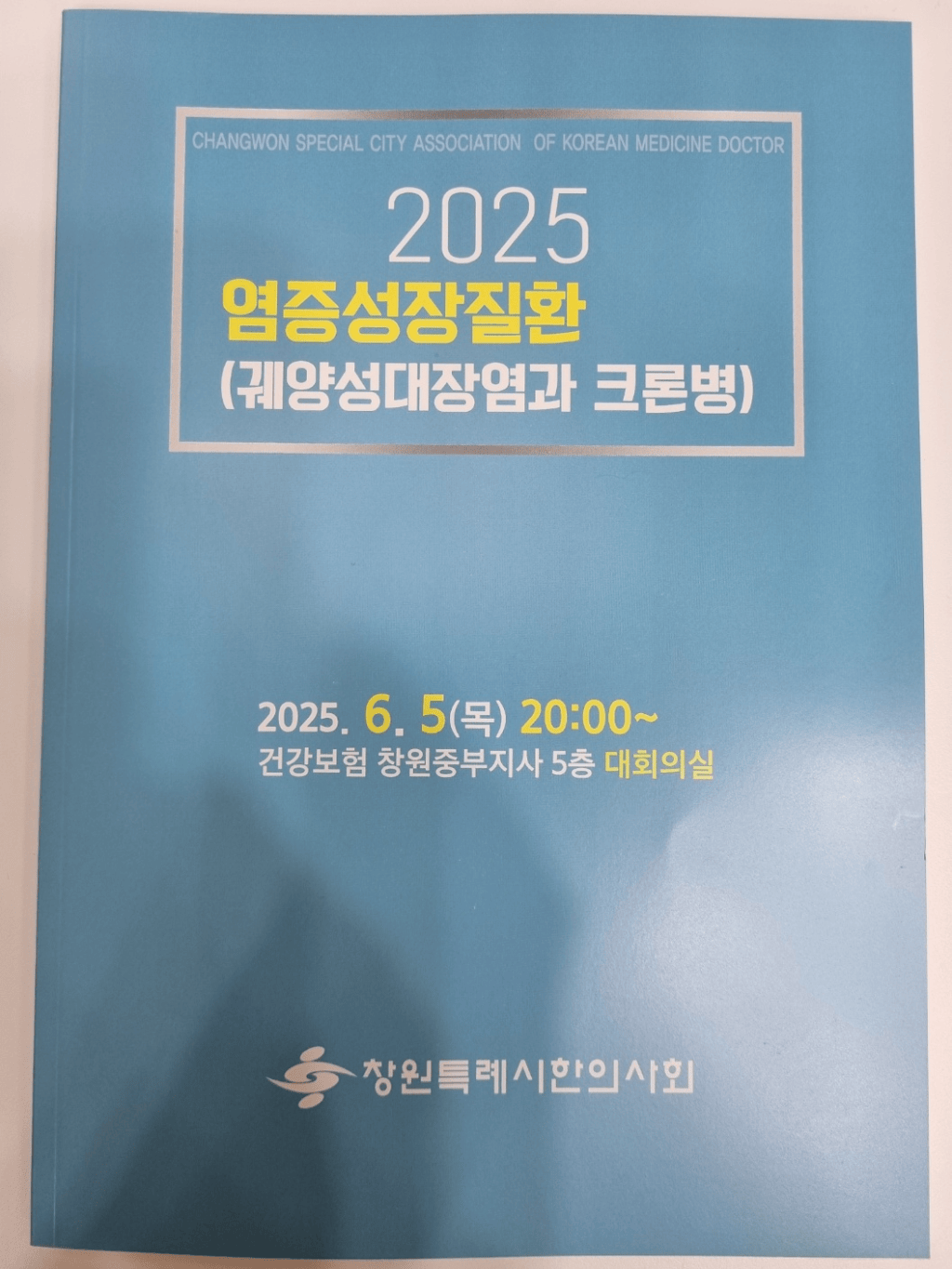
So at the beginning of this June I was invited to lecture at a continuing education session held by a city Korean medicine doctors’ association.
Even after graduating, Korean medicine doctors have to keep taking about eight credits of lectures a year to maintain their licence.
So lectures are held on the latest findings in medicine. And of course the lecturer they invite will be someone credible and verified.
I was invited as the lecturer for that continuing education session.
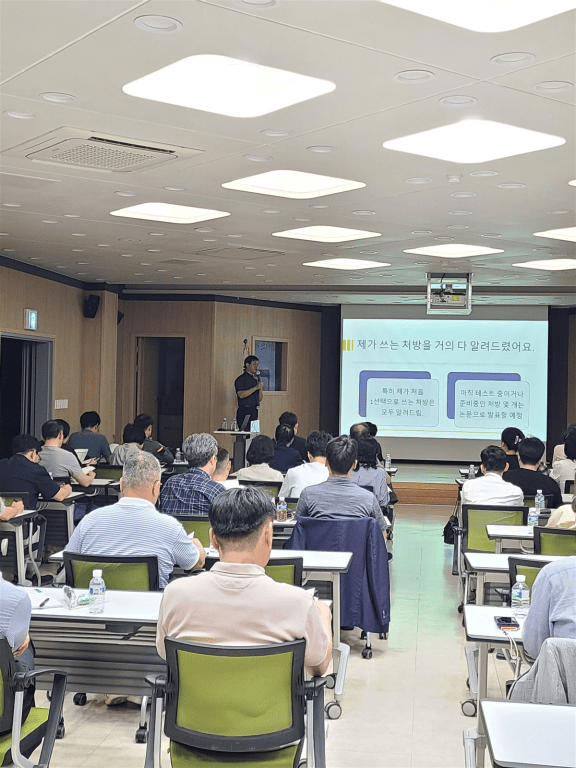
Many Korean medicine doctors from the city attended.
I had prepared so much material that I ran over time and lectured for nearly three hours. Not one person left their seat. They listened enthusiastically to the end and asked questions, and it was a stimulating occasion for me as well.
I heard afterwards that many of them rated the content highly and said it was a really interesting lecture. For a lecturer, that is a very good thing to hear.
Because I have become somewhat known among Korean medicine doctors in this way, patients sometimes come to me on the referral of another Korean medicine doctor.
The patient with ulcerative colitis I want to introduce today is one of them.
The doctor who referred her mainly treats rheumatoid arthritis.
This patient’s older sister had been treated for rheumatoid arthritis at his clinic.
Rheumatoid arthritis is also an autoimmune disease, and Western medicine cannot cure it.
But the older sister had her rheumatoid arthritis treated at that Korean medicine clinic.
So, since her younger sister had ulcerative colitis — the same kind of autoimmune disease — she took her to that clinic.
And that doctor said: ah, for ulcerative colitis, go to Hanstep Korean Medicine Clinic.
The truth is that among Korean medicine doctors we know who is good at what. I also refer patients to other clinics for the things I am not good at.
So she came to Hanstep Korean Medicine Clinic in February 2025.
Her symptoms had first started around April 2023.
Blood was dripping from her, and at first she thought it was hemorrhoids.
After an examination at a proctology clinic she was transferred to a university hospital, and in July 2024 she was diagnosed with ulcerative colitis.
The Western medication she was taking when she came to me was Mezavant, four tablets a day, and a Pentasa suppository once a day.
Bowel movements once a day, but blood kept dripping.
Under stress her chest felt tight and her abdomen hurt.
Her appetite was fine, but she ate only about 0.7 of a portion. A little small, isn’t it?
Her digestion had never been good, and she felt bloated.
Under stress the digestion got worse.
She had reflux esophagitis.
Cold food and spicy food made her stomach uncomfortable.

The stool calprotectin tested on February 26 was 1,582. Very high. And the fecal occult blood was positive at over 1,200. The bleeding was unmistakable.
There is a digestive disorder here.
So we went with a prescription that treats the digestive disorder and the colon inflammation together.
A month after starting the herbal medicine, the blood was only a little at the end of the stool.
Her meal size had gone up to a full portion. The indigestion was almost gone.
Two months in, by April:
Bowel movements once a day, a little blood still showing at the end.
Eating and digestion good. Eating a full portion.
Digestion fine even under stress. The abdominal pain was gone.
The upper-digestive problem and the abdominal pain had disappeared completely, but some blood was still left, wasn’t it?
Now — in a case like this, there is usually another cause besides the upper-digestive problem, and that is why it does not finish.
What has to be done? The prescription has to be changed.
If the second prescription is also changed appropriately, it will go well again. And if it misses, you write another prescription.
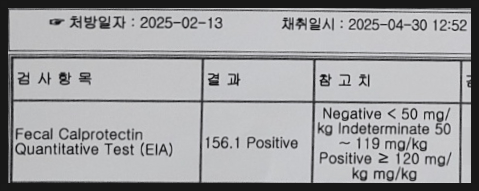
On April 30 she had a test at the hospital, and the calprotectin was 156.1 — an enormous improvement.

And as the bleeding decreased — at first her hemoglobin was 9.6, well below the normal value of 12 —
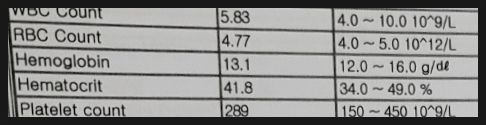
it rose all the way to 13.1.
This shows that anemia, a common complication in patients with ulcerative colitis, improves naturally as the bleeding decreases.
After changing the herbal prescription, by June:
Bowel movements once a day. No blood, no mucus.
Eating and digestion good.
No abdominal pain at all.
The indigestion under stress and the abdominal pain were all gone.
Even these things improved.

The stool calprotectin on June 2 was 32.
The first value was 1,582, and four months later it was 32.
An enormous improvement, isn’t it?
Talking with her, I asked whether she had felt uneasy or worried about Korean medicine treating ulcerative colitis.
She said that because she had been referred by the clinic that treated her sister’s rheumatoid arthritis, she had not felt particularly worried.
Looking at this, I sometimes wonder whether there really is such a thing as fate in how a doctor and a patient come to be connected and treatment comes about.
And this patient’s indigestion under stress, and the abdominal pain that worsened with it, also improved.
Why? Because among the herbs in the prescription that treats ulcerative colitis, there are medicines that bring down the balance of an over-excited sympathetic nervous system — in today’s common term, medicines that treat autonomic dysfunction. That is why these things are treated too.
This is possible because herbal medicine is not a single compound but a multi-component, multi-target preparation.
In Western medicine too the latest trend is moving toward personalized medication tailored to the individual, and research into multi-component, multi-effect approaches is active.
The Western drugs of the future will probably resemble herbal medicine much more closely.
Today we looked at a case of a patient with ulcerative colitis who came on the referral of another Korean medicine doctor.
This is Hanstep Korean Medicine Clinic.
Thank you.
If you have questions about ulcerative colitis or Crohn’s disease, calprotectin, or anemia in IBD, please leave a comment. I read them and take them up as topics.
▶️ Watch our YouTube video on this case:
https://youtu.be/8ymhoH6GTaI
Please turn on subtitles to watch.
HanStep Korean Medicine Clinic – Inflammatory Bowel Disease Clinic
https://hanstep.co.kr/en/


Leave a Reply