Hello. We are Hanstep Korean Medicine Clinic, researching and treating ulcerative colitis since 2007.
Today I want to look at a case where steroids simply did not work.
The patient is a man in his thirties.
In July 2023 he began passing blood in his stool, was examined at a general hospital, and was diagnosed with ulcerative colitis.
At first he took only Asacol, and he says he did well for about a year.
Asacol, Pentasa and Mezavant are all 5-ASA agents. Anti-inflammatories.
I say this all the time.
If you use a 5-ASA agent in the early stage of ulcerative colitis, remission does sometimes come, for a year or two.
But once that year or two has passed, it relapses — and at that point, taking more of the 5-ASA agent does nothing.
So a lot of people, because the Western medication works well at first, take it lightly. Then they go through the cycle of getting steadily worse, and they lose their trust in the medication.
He did well until October 2024. From October the abdominal pain started, and by December the pain and the bleeding got sharply worse, so he was admitted.
He was put on Solondo, a steroid, 6 tablets a day, and improved somewhat.
He was discharged after two weeks on 4 tablets of Solondo, but he got worse again. This time he took 8 tablets of Solondo, and it had no effect, so in January 2025 he was admitted again.
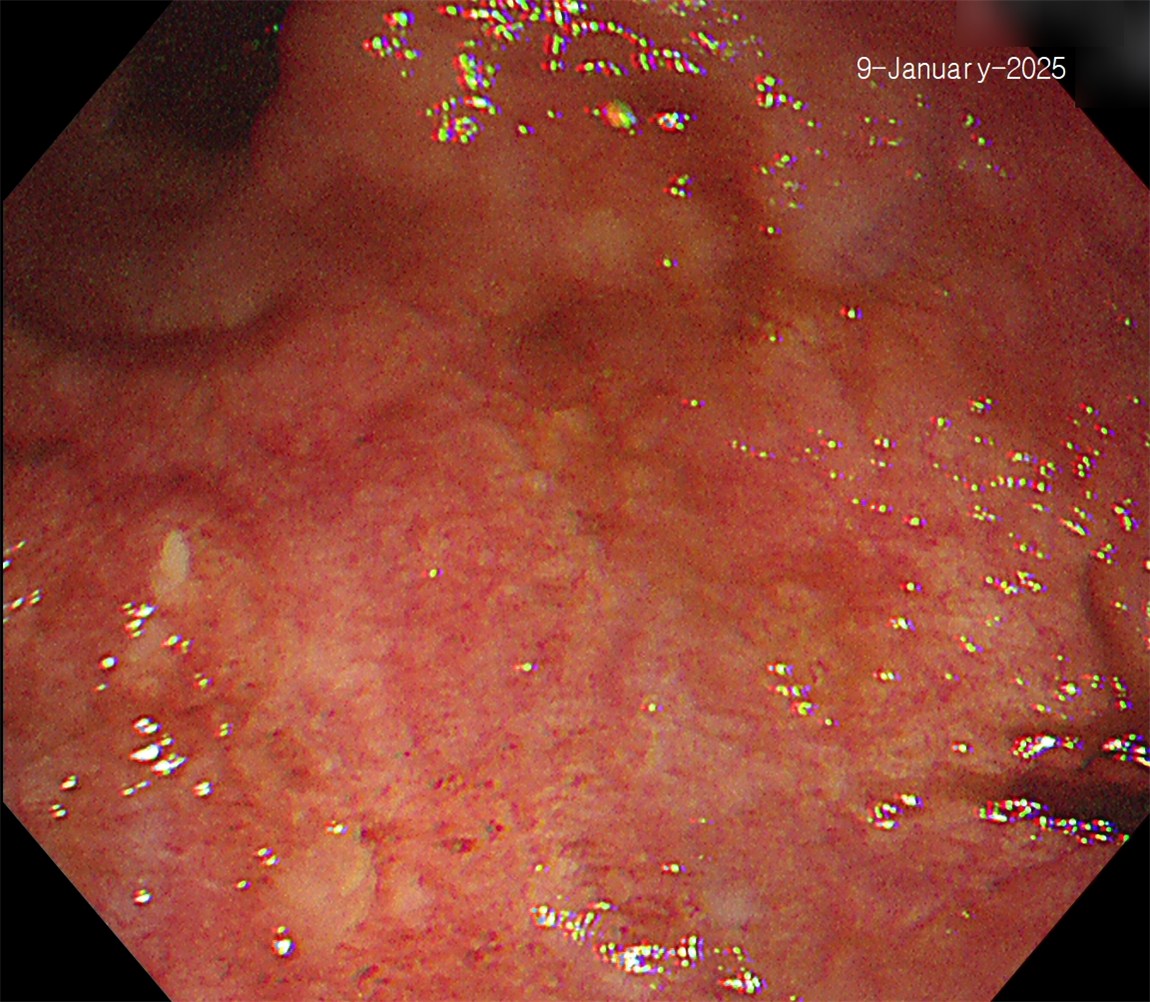
These are the colonoscopy images from January 2025. Here the mucosa is diffusely red and granular, the vascular pattern is gone, and small erosions are scattered all over it.
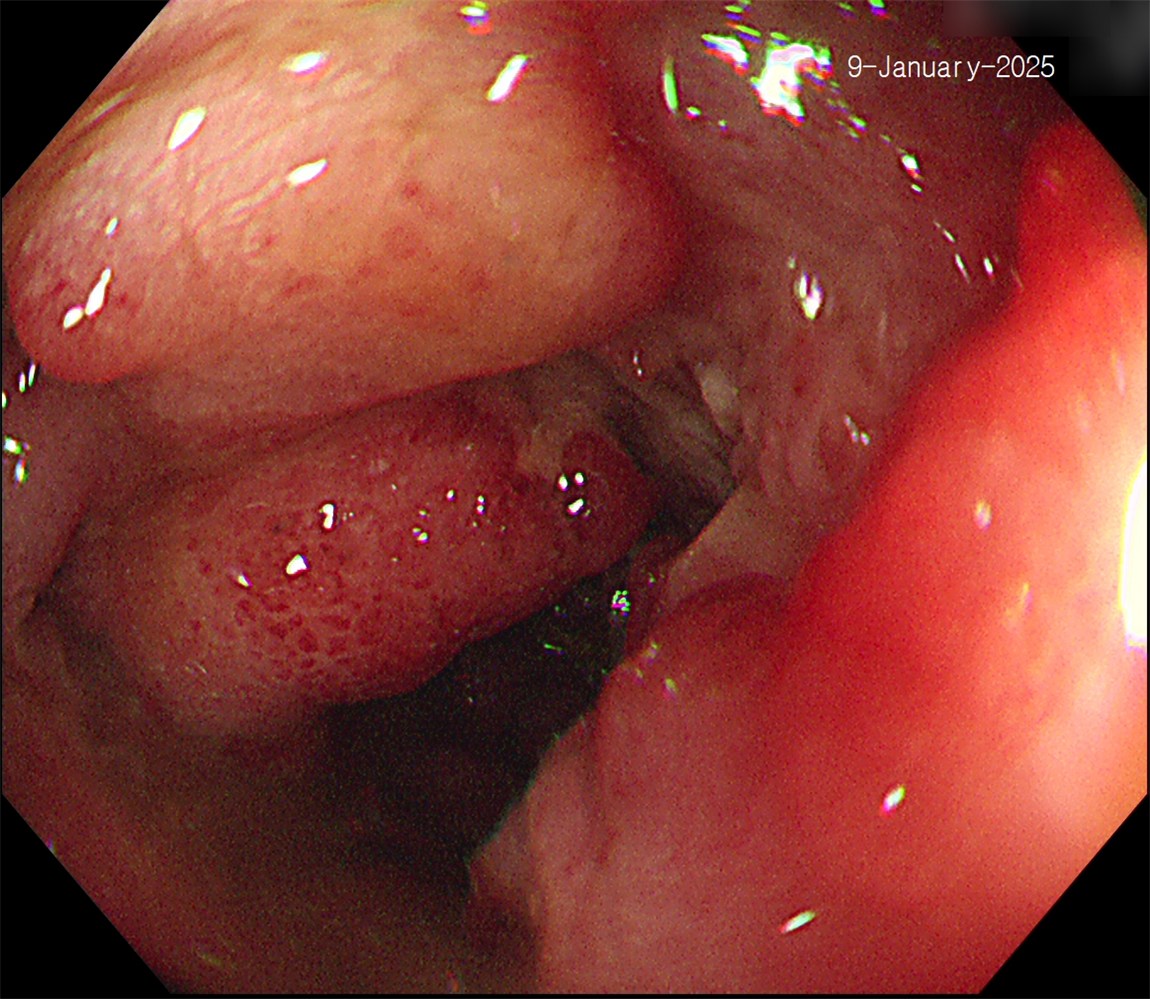
Here the mucosa is swollen and heaped up into mounds, with deep grooves between them.
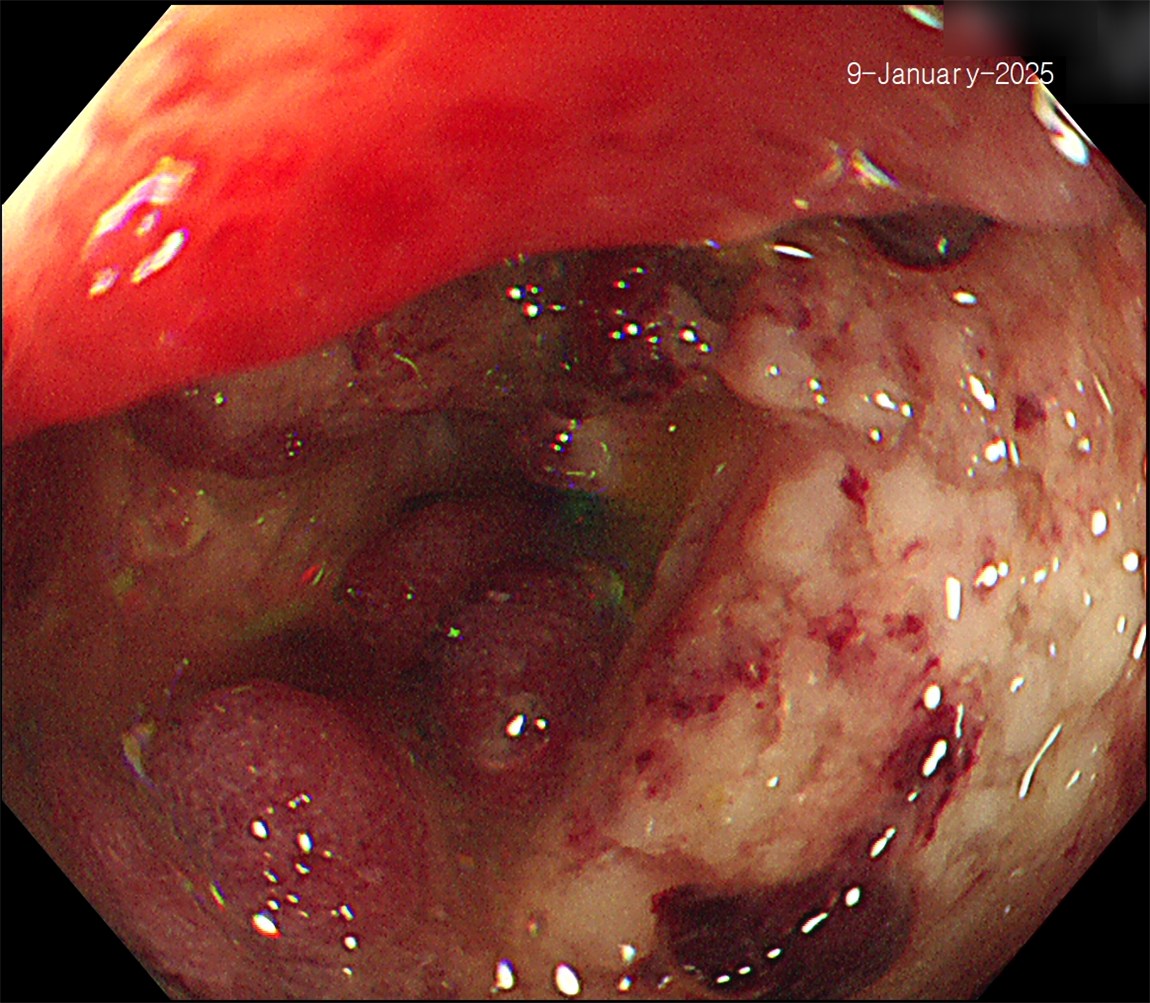
And here is the worst of it — a broad field of yellowish-white exudate, which is the floor of the ulceration, with fresh bleeding on it.
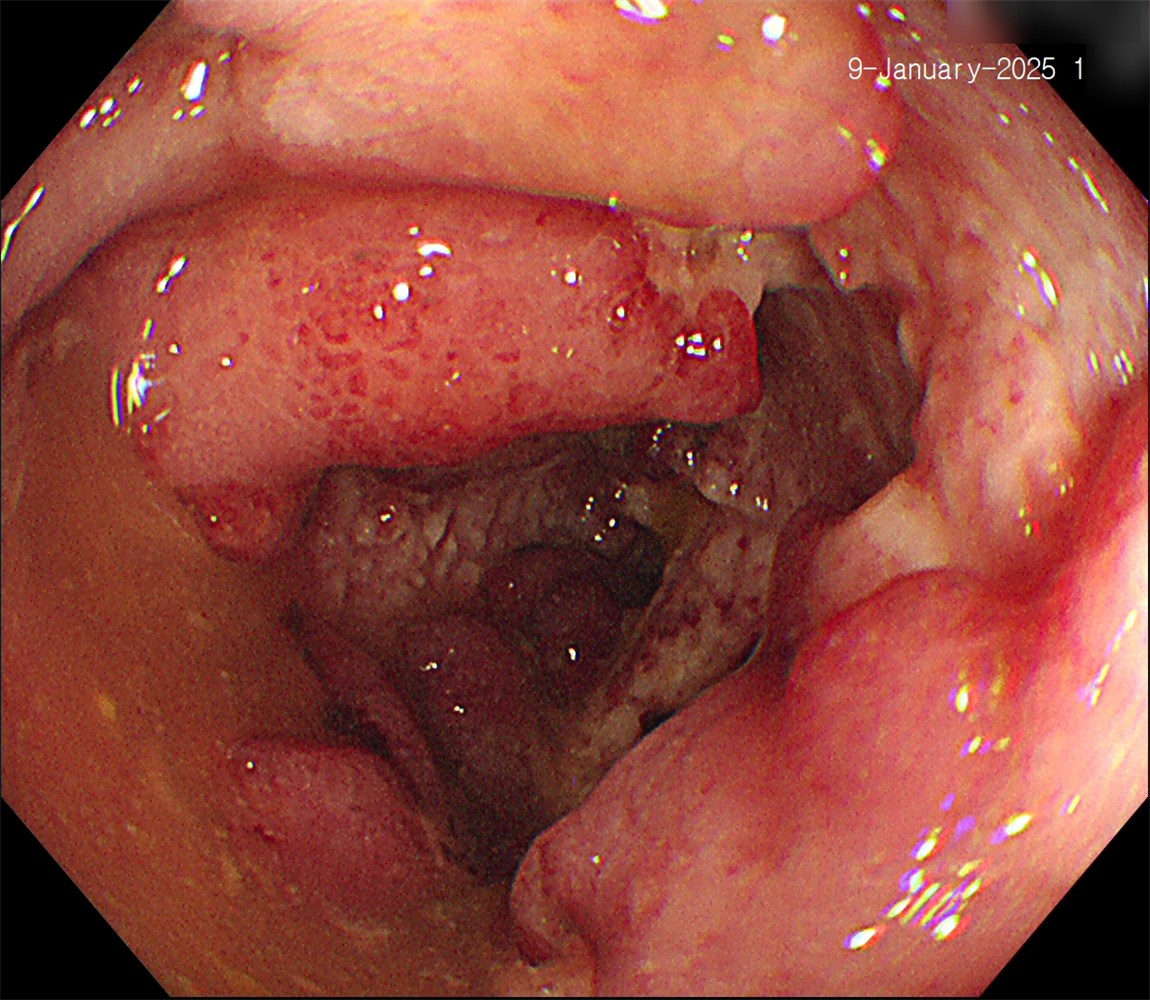
Here too the bowel wall is swollen into cobblestone-like mounds, and the surfaces are eroded.
The colonoscopy showed it had gotten worse, so he was given steroids by injection, improved a little, and was discharged.
He went from 8 tablets of steroid down to 4, got worse again, had another steroid injection, and went back to 8 tablets of Solondo.
Solondo is prednisolone — a powerful steroid.
Steroids are powerful anti-inflammatories.
We can usually divide medications into ointments applied to the skin, oral medication, and injections.
Ointments and creams applied to the skin are absorbed through the skin at a very low rate, so they have the least systemic effect.
Even so, steroids are prescribed a great deal for psoriasis and atopic dermatitis.
Apply it and things are fine; stop applying it and things get worse — so a lot of people end up overusing it badly.
Oral medication is the form you take by mouth.
When we eat something, almost all of it is digested in the stomach, absorbed in the small and large intestine, and then it all goes to the liver.
In the liver, everything harmful to the body is broken down and detoxified, and only then is it sent into the blood.
So only what has been detoxified circulates in the blood.
That means oral medication is filtered once by the liver, so its effect on the body is somewhat less.
Finally there are injections — subcutaneous, intravenous and so on — and these go straight into the blood.
So they circulate through the whole body immediately.
Because they enter the bloodstream and act without passing through the liver’s detoxification, their effect on the body is the greatest.
And that is why, in this patient’s case, large amounts of the oral medication did nothing, but the injection had some effect.
Steroids should not be used in these amounts, for this long. But when there is no other option, this is what happens.
The steroid was not working, and reducing it made things worse, over and over — so on February 3, 2025 he came to Hanstep Korean Medicine Clinic.
At that first visit he was taking Solondo 8 tablets, Pentasa 4 tablets, and also an antispasmodic and an anticholinergic.
Antispasmodics and anticholinergics are used to reduce diarrhea a little. Patients with ulcerative colitis must never take them.
Doctors prescribe them because they do not know better, but you should not be taking them.
I have explained the reason before.
It is too long to explain here, so I will come back to it another time.
He had also been prescribed an acid suppressant and a painkiller.
He was taking 8 tablets of the steroid Solondo — 40 mg a day.

And on February 7, fecal calprotectin was 5,293, with fecal occult blood positive at over 1,200.
When calprotectin is over 5,000, the inflammation is extremely severe. At that level, the steroid is doing nothing at all.
At the first visit on February 3, 2025, he was 166 cm and 53 kg — 7 kg down from his usual weight.
Bowel movements 4–8 times a day. Diarrhea that broke apart like powder, with urgency.
No visible blood at that point, but mucus kept coming.
He himself said there was no blood — but the test was positive for it.
This happens very often. Blood you cannot see is not the same as no blood.
Pain in the upper abdomen.
Normally a mild ache, but in the evening or the early hours, severe abdominal pain.
Gas built up and made his abdomen hurt.
At the change of seasons, and with pollen and dust, a great deal of clear runny nose and sneezing — and his nose was blocked even at the best of times.
A respiratory-type problem showing itself.
He had atopic dermatitis as a child.
One or two nights a week he sweated cold sweats in his sleep.
Since starting the steroid, his face was swollen and his legs had no strength.
Legs losing their strength is classic adrenal insufficiency — a symptom that comes from using steroids in too high a dose, for too long.
The night sweats are also a steroid side effect.
The rhinitis is very severe, isn’t it?
For this patient, the respiratory side looked like the biggest cause of his ulcerative colitis.
So the first prescription I started with was a respiratory-type prescription.
And I told him to stop the antispasmodic and the anticholinergic immediately.
The hospital also agreed to taper the Solondo by one tablet a week.
February 14.
Bowel movements 5–6 times. The urgency had eased somewhat.
The severe abdominal pain was down by about 50%.
The nasal congestion had eased, and the night sweats were gone.
February 25. Down to 5 tablets of Solondo.
Bowel movements 3–4 times.
The raw, burning feeling across his whole abdomen was down by 40–50%.
The everyday upper abdominal pain was almost gone.
Almost no nasal congestion either.
March 14. Down to 3 tablets of Solondo.
Bowel movements twice. Normal stool. No urgency, and no mucus.
The severe abdominal pain was gone as well.
He is getting better as the steroid comes down.
And this is a man for whom 8 tablets of steroid had done nothing.
Then on March 30 the steroid was stopped completely.
Through April 8, bowel movements 1–2 times, normal stool.
Very good.
But from around April 10 the stool went loose again and turned into diarrhea.
Bowel movements 4–5 times.

On the April 18 test, calprotectin was 2,340.
Down a great deal from 5,293, but still high.
Once the respiratory type had been treated, the next cause was revealing itself.
So on April 25 I switched him to an upper-digestive prescription.
May 10.
Bowel movements 3–4 times. The urgency was gone.
The facial swelling from the steroid was gone too, and the strength in his legs had come back completely.
From the end of May I switched to an inflammation-type prescription.
But in June another rough patch came.
On June 18 he had a wisdom tooth out, and was prescribed an anti-inflammatory painkiller and an antibiotic, which he took.
After that his bowel movements suddenly went up to 10 a day.
Small amounts at a time, mostly urgent, and he thought he could see some blood.
I say this all the time.
If a patient with ulcerative colitis takes antibiotics and anti-inflammatory painkillers, the symptoms easily get worse.
Even something that looks as minor as having a wisdom tooth out is something you have to be careful about.
So I changed him to a different prescription within the inflammation type, and brought it back under control.
July 19. Bowel movements 6–7 times.
August 5. Bowel movements 3–4 times. The stool was taking shape.
August 18. Bowel movements 2–3 times. Normal stool. The urgency was gone. No blood, no mucus.

On the September 12 test, calprotectin was 309.
From 2,340 down to 309.
His health had improved so much that in October 2025 he went travelling in Southeast Asia.
After he came back he had abdominal pain, and when he held his stool in and then went, there was some blood.
As the weather turned cold, the rhinitis came back too.
Coughing in the morning, runny nose, blocked nose.
When the rhinitis comes back, the abdomen starts hurting again.
That is the signal that the respiratory-side problem is still there.
So we treated with a respiratory-type prescription again.
When you look at the patients whose treatment drags on, many of them have this kind of stubborn respiratory problem.
Even after treatment has made them better, when the seasons change and the rhinitis gets worse again, the symptoms can come back like this.
So you have to treat with a bit more persistence.
Besides respiratory problems, I also see a fair number of cases where eating in a hurry and swallowing without chewing properly brings the digestive problem back, and the ulcerative colitis relapses with it.
You have to build the habit of always eating slowly and chewing thoroughly.
October 29. The abdominal pain, the bleeding and the heartburn were all gone.
The rhinitis symptoms were down by about 80%.
In December his abdomen ached slightly — and he tells me the rhinitis was bad at that time.
The abdomen and the nose move together, don’t they?
That is exactly what characterizes the respiratory type.

On the January 2, 2026 test, calprotectin was 891.
Up slightly from 309.
The abdominal pain had also crept up to once or twice a day.
So I switched him back to an inflammation-type prescription.
The interesting part is that he spent a few days in the Philippines for business, and he says that during that time his abdomen did not hurt at all.
Going somewhere warm reduced the load on the respiratory side, and his abdomen settled with it.

March 11. Calprotectin 260.

May 4. Calprotectin 152.

June 15. Calprotectin 22.
Finally normal.
So we reduced the Pentasa from 4 tablets to 2.

August 24. Calprotectin 49.
Even with the Pentasa reduced, it is holding normal.
So from September he stopped the Pentasa.
Let me sum up.
This was a man for whom 8 steroid tablets a day, and injections on top of that, did nothing.
Calprotectin 5,293.
He started herbal treatment, and the steroid was stopped within two months.
Then respiratory type, upper-digestive type, inflammation type.
When the rhinitis came back, respiratory type again, and then inflammation type again.
I changed the prescription to match the order in which the causes revealed themselves.
Calprotectin went from 5,293 to 22, then 49 — normal.
And the steroid, the antispasmodic, the anticholinergic and finally the Pentasa — all of the Western medication was stopped.
But there is one thing I regret.
Normally, when I finish treating ulcerative colitis, I do a colonoscopy and confirm that it has completely resolved before ending treatment.
With this patient, once the symptoms had all gone and the numbers were stable, he simply ended treatment.
Not finishing it perfectly, right to the end, is the part I regret.
In the last video I talked about a patient whose calprotectin was normal but whose colonoscopy still showed inflammation, didn’t I?
Calprotectin can miss small inflammation.
If you do not confirm with a colonoscopy that treatment has finished cleanly, small inflammation left behind can grow again.
There is some risk of relapse.
If the symptoms are gone and the numbers have come good, you are almost all the way there.
Confirm that last step, and finish the treatment properly.
If you have questions about steroid treatment or calprotectin testing, please leave them in the comments. I read them, and I take them up as topics.
This is Hanstep Korean Medicine Clinic.
Thank you.
▶️ Watch our YouTube video on this case:
Please turn on subtitles to watch.
HanStep Korean Medicine Clinic – Inflammatory Bowel Disease Clinic


Leave a Reply