Hello.
We are Hanstep Korean Medicine Clinic, researching and treating ulcerative colitis since 2007.
The thing patients ask me about most often in consultation is relapse.
Once ulcerative colitis has been treated, will it come back?
The honest picture is this. 5-ASAs, steroids, immunosuppressants, biologics — all of them are drugs that suppress inflammation.
They suppress it powerfully, so Western medication can certainly work.
But when the medication is reduced or stopped, the symptoms come back.
And all of these drugs have side effects, which makes them poorly suited to long-term use.
So when the medication is stopped, most people relapse before long.
Naturally, patients assume herbal medicine works the same way. You take it, you get better, and when you stop, it comes back — doesn’t it?
There is something I always tell my patients.
I say that I treat ulcerative colitis.
In conventional medicine the phrase used is “induction of remission.”
That is because the view there is that ulcerative colitis has no cure.
So instead of the word “treatment,” the term “induction of remission” is used.
But when ulcerative colitis is treated with herbal medicine, “treatment” is the right word.
Once it has been properly treated, stopping the herbal medicine does not bring it back.
Among my patients there are many who have gone five years, ten years and more without any medication at all, Western or herbal, living normally with no relapse.
So — once you treat ulcerative colitis with herbal medicine, does it never come back for the rest of your life?
If you ask me that, the answer is that it can still come back after herbal treatment.
There is no illness in the world that you treat once and never get again for as long as you live.
You caught a cold last winter and you got over it.
Does that mean you will not catch a cold this year, or next year?
Of course not.
If the particular causes that provoke a relapse are supplied again, a relapse can happen.
The reason Korean medicine can properly use the word “treatment” is that it identifies exactly what is causing the ulcerative colitis and treats that cause.
And because we know what the relapse factors are, we can work on not supplying those causes again.
And if a relapse does happen, we know the cause, so we can treat it again.
I classify ulcerative colitis into six types.
Upper-digestive type
Inflammation type
Respiratory type
Cold-abdomen type
Edema type
Reduced-colonic-function type
Each of these types has its own underlying cause.
The two I see most often are the upper-digestive type and the respiratory type.
And a relapse driven by those same two causes coming back is something I see fairly often.
Let’s look at today’s patient.
A patient in their thirties with ulcerative colitis.
In August 2024 they began passing blood and having diarrhea.
In September 2024 a colonoscopy was done and ulcerative colitis was diagnosed.
They came to Hanstep Korean Medicine Clinic in March 2025.
They stopped the Western medication straight away and were treated with herbal medicine alone.
Treatment was completed in six months, and we finished in August 2025.
Then, on October 20, 2025, this patient came back.
From early October the abdomen had become slightly uncomfortable again, and then blood in the stool and diarrhea had appeared.
Stools were six times a day, loose, with blood.
No appetite. Eating a full portion left the stomach feeling overloaded.
Slight abdominal pain before passing stool.
And as the weather turned cold, the rhinitis symptoms had come back.
The nose was a little blocked, with a feeling of something caught in the throat.
The abdomen felt somewhat cold too.
This is exactly the change of season.
As the weather turned chilly the rhinitis came back up, and the bowel went down with it.
I said earlier that the two most common types are the upper-digestive type and the respiratory type.
This patient is precisely a case of those two causes becoming a problem again.
Because the appetite had dropped and even a small amount of food felt heavy, I started treatment with an upper-digestive prescription first.
But at this point something else happened.
A stone suddenly formed in the salivary gland under the jaw.
A stone in the salivary gland.
So at the end of October they were admitted to a university hospital, put under general anaesthesia, and had surgery to remove the stone.
And after the surgery they took antibiotics.
When I saw them again on November 12, 2025, stools had risen to nine a day.
Each trip to the toilet meant going three times.
Diarrhea, with blood.
Lower abdominal pain before passing stool.
Food intake had dropped to half a portion.
Considerably worse.
This is something I say constantly.
When a patient with ulcerative colitis takes antibiotics, the symptoms easily get worse.
Antibiotics do not only wipe out the harmful bacteria — they wipe out the good bacteria living in the gut along with them.
When the balance of gut bacteria is broken, the intestinal mucosa weakens and inflammation comes up more easily.
Of course, after surgery there are times when antibiotics absolutely must be used to prevent infection.
In those situations they have to be used.
But if you have ulcerative colitis, you need to know that your bowel may get worse while you are taking them.
And for this patient it did not end there.
Because they could not chew on the operated right side, they chewed only on the left — and this time inflammation developed in the left jaw.
So they took another course of antibiotics.
It really was a difficult stretch.
Even so, they kept taking the herbal medicine throughout, and by the end of November 2025 stools were down to six or seven a day, and the lower abdominal pain had reduced by about 50%.
Food intake was back to a full portion.
Mid-December 2025: the jaw inflammation settled and the antibiotics were stopped.
Stools six a day. Formed stool and diarrhea mixed together. Blood occasionally.
The abdomen still felt cold.
As the weather got colder, the toes felt chilled.
Even normally the feet felt cold, so they wore thick socks.
Digestion was fine by now.
Which means the next cause had surfaced.
Sensitive to cold, rhinitis at the change of season, cold abdomen and cold feet.
So on December 13, 2025 I switched them to a respiratory-type prescription.
Two weeks later the cold feeling in the abdomen had lessened, and so had the chill in the toes.
By January 2026 the cold feeling in the abdomen and the chill in the toes had both gone completely.
Stools were down to five a day.
So on January 12, 2026 I switched them to an inflammation-type prescription.
From here on it was a matter of bringing the inflammation under control.
Mid-February 2026. Five or six trips to the toilet, but mostly gas and discharge; actual stool about twice in two days.
Blood still appeared occasionally.
So I changed to a different prescription within the same inflammation type.
Late March 2026. Actual stool once in two days, normally formed.
Almost no urgency, and passing stool completely, with no feeling of anything left behind.
The blood had decreased a great deal, and the lower abdominal pain before passing stool had gone.
In April 2026, stool once a day, normally formed.
A little blood about once every two days.
So from April 20, 2026 I changed the inflammation-type prescription once more.
Mid-May 2026. One or two trips to the toilet a day, normally formed. No urgency, and the blood had gone.
By this point the symptoms were almost entirely resolved.
Then we ran a test.

On May 20, 2026, fecal calprotectin was 968. Normal is under 50, so that is quite high.
The symptoms had almost completely improved, but the number was still high.
This is the thing I say every time.
Symptoms improving does not mean the inflammation has all gone.
Which is exactly why you have to confirm it with a test.
We carried on with the same prescription.

On June 15, 2026, fecal calprotectin was 51.
From 968 down to 51 — a sharp drop in a single month.

On July 15, 2026, fecal calprotectin was under 3.8.
Finally normal.

On August 12, 2026, fecal calprotectin was 9.4, and the quantitative fecal occult blood test came back at 15 — reported as negative.
No symptoms, and the numbers staying normal.
This relapse was treated with herbal medicine alone, with no Western medication.
And in September 2026 we did a colonoscopy.
Right — let’s compare the colonoscopy images.
These are from before the herbal treatment, in September 2024.
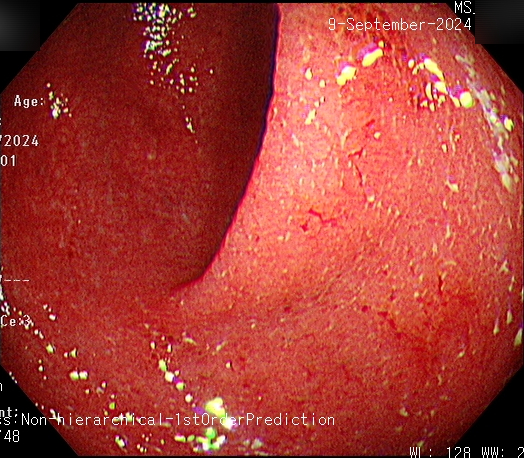
The sigmoid colon and the rectum. Red and congested. The inflammation is severe.
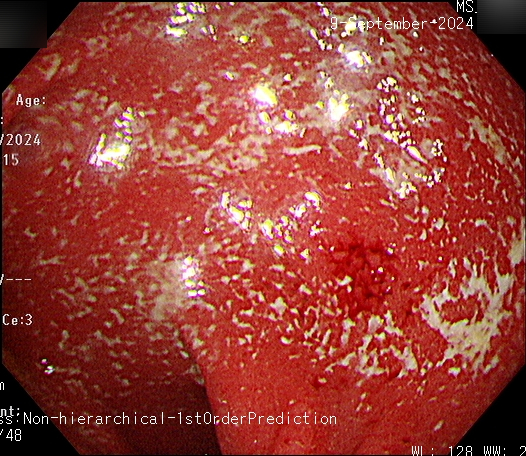
The mucosa is badly swollen and bleeding.
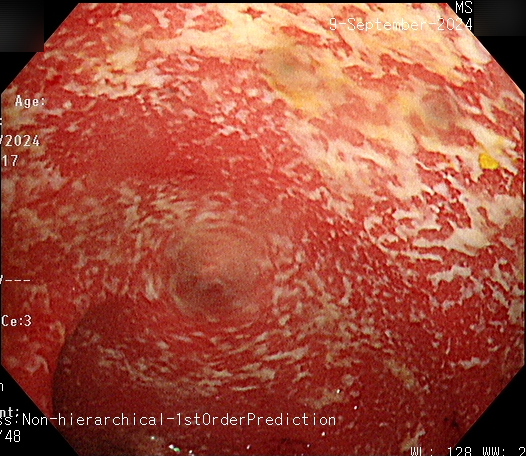
Bleeding here as well, with heavy inflammation and mucus.
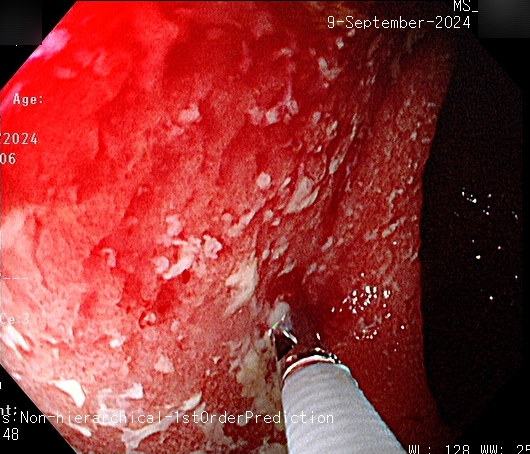
A biopsy is being taken here.
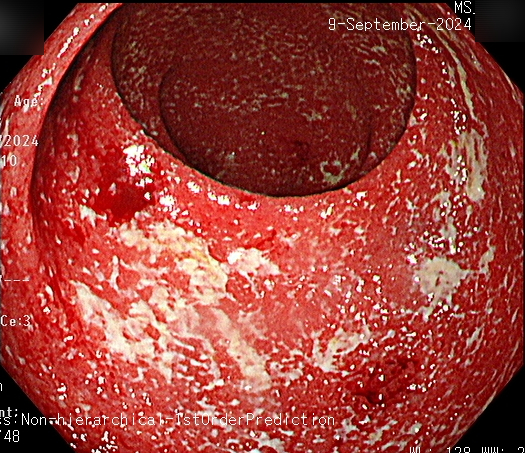
Inflammation and exudate across the whole surface.
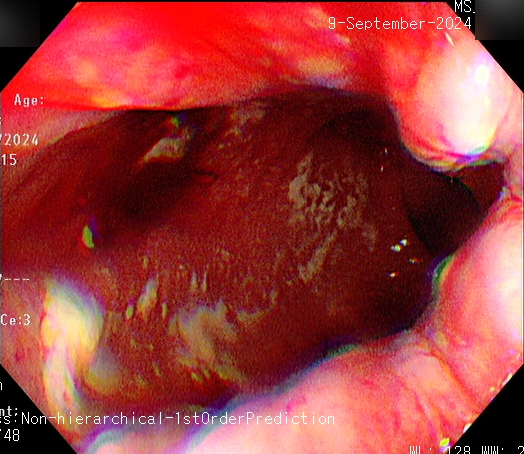
And the rectum at the end — severely swollen, and you can see it bleeding.
These are the images from September 2026.
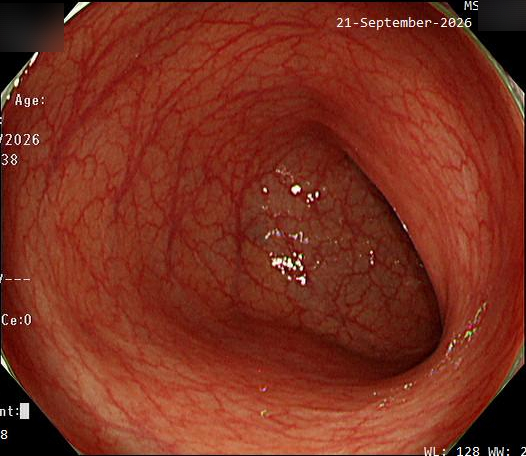
Completely different from the earlier pictures. No congestion anywhere, the vascular pattern is clearly visible, and there is nothing swollen or bleeding.
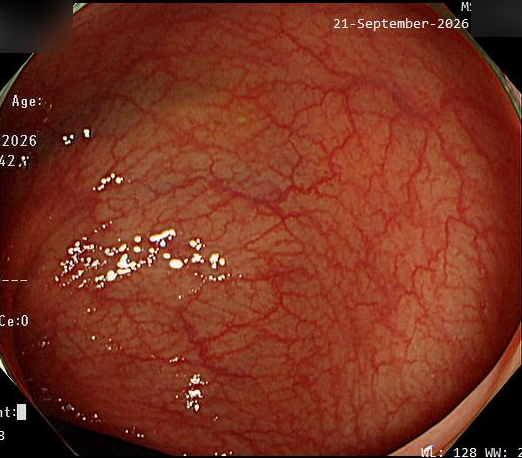
This one looks very clean too.
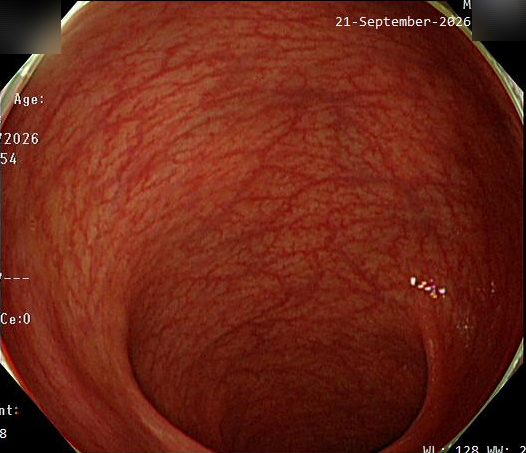
Clean and sharp here as well.
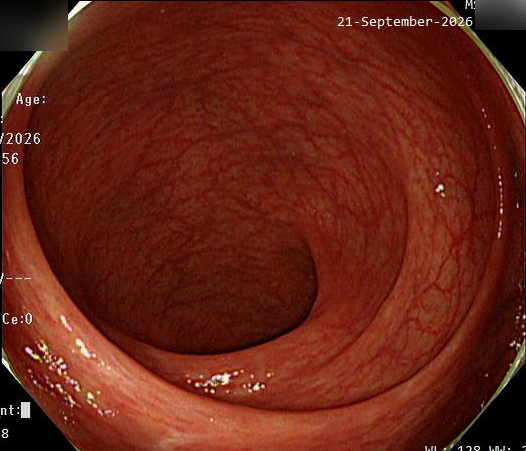
This is very good.
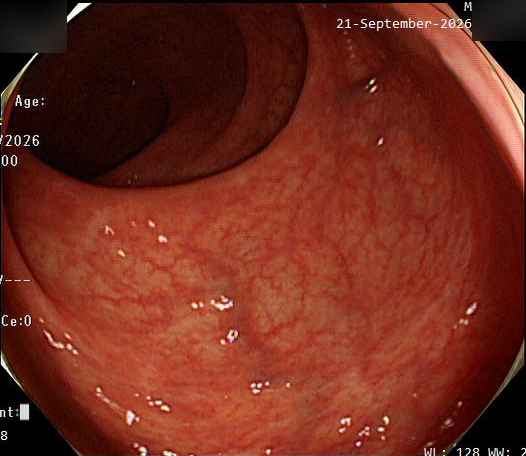
No congestion and no bleeding to be seen here either.
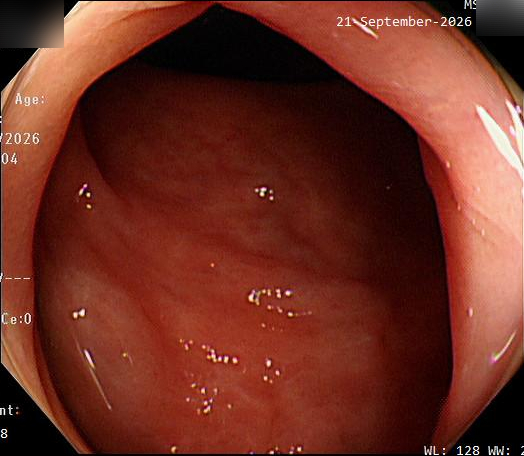
And the rectum at the end — completely different from the earlier picture.
This is the result of treatment with herbal medicine alone, without taking any Western medication at all.
We confirmed the full recovery on colonoscopy and then finished treatment.
Let me sum up.
This patient relapsed two months after finishing their first course of treatment.
There were two causes of the relapse.
The first was seasonal rhinitis.
As the weather turned cold the rhinitis came back, and the bowel went down with it.
The second was antibiotics.
After the salivary gland stone surgery, and then because of the jaw inflammation, they took two courses of antibiotics, and the symptoms got considerably worse.
Even so, because we knew the causes, we were able to treat those causes one by one.
Upper-digestive type, respiratory type, and then inflammation type.
And that is how we got to normal calprotectin, a negative occult blood test, and a clean colonoscopy, and finished the treatment.
So — what should you do to prevent a relapse?
Relapse in ulcerative colitis almost always has a cause.
When the cause that produced the illness in the first place is supplied again, you relapse.
If you are the respiratory type, like this patient, you have to be especially careful at the change of season.
When the weather turns chilly, dress warmly, keep your neck and abdomen from getting cold, and manage things so that colds and rhinitis do not take hold.
And antibiotics and anti-inflammatory painkillers should only be used when they are genuinely needed.
When you are given a prescription at another clinic, always tell them that you have ulcerative colitis.
And if a sign of relapse appears, come in quickly.
This patient came in two weeks after the symptoms started.
The earlier you come, the sooner the treatment is finished.
The reason relapse is frightening is that you do not know the cause.
If you know the cause, you can prevent it — and if you do relapse, it can be treated again.
If you have questions about Crohn’s disease, ulcerative colitis, or preventing relapse, please leave them in the comments. I read them, and I take them up as topics.
This is Hanstep Korean Medicine Clinic.
Thank you.
▶️ Watch our YouTube video on this case:
Please turn on subtitles to watch.
HanStep Korean Medicine Clinic – Inflammatory Bowel Disease Clinic


Leave a Reply