Hello.
This is Lee Byunghee, director of Hanstep Korean Medicine Clinic.
Today I want to look at how Korean medicine can treat ulcerative colitis and Crohn’s disease.
I gave the original talk the title “For Korean medicine doctors only,” but of course people outside the profession will read it too, so I will start with the basics and work up to material that really takes a practitioner to follow.
The fact is that these days, with Western medicine on television constantly, even people with no medical training have a rough idea of what liver enzymes are, or what a vaccination does.
But when it comes to Korean medicine, there seem to be a great many people who know nothing at all.
So today I want to talk about the fundamentals.
Were ulcerative colitis and Crohn’s disease really treated 2,000 years ago?
Let us look at the basics of Korean medicine.
The treatment theories and methods of Korean medicine are enormously varied, and I cannot cover all of them, so today I will look only at herbal medicine.
In Korean medicine, in the herbal field, there are three main schools.
1. Gobang — the Classical Formula school
2. Huseibang — the Later Formula school
3. Sasang — the Four Constitutions school
Those are the three. “Bang” here means formula or prescription. So: classical formulas, later formulas, constitutional formulas.
To put it simply, it is like martial arts. Taekwondo, judo, boxing — each uses the body in a somewhat different way.
In the same way, even when the same herbs are used, the theory behind their use and the formulas themselves differ from school to school.
Let us look at each of the three properly.
The Classical Formula school
Gobang literally uses the character for “old,” so it means exactly that: old formulas. The ancestral bird of herbal prescribing, if you like.
The foundational texts of this school are the Shanghanlun and the Jingui Yaolue.
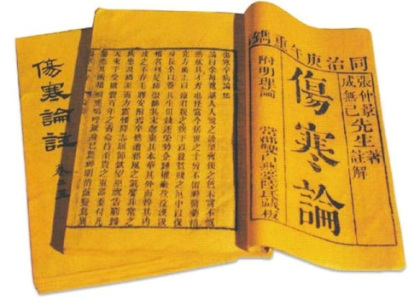
The Shanghanlun is thought to have been written around 1,800 to 2,000 years ago. Roughly the time of the birth of Christ.
As its name suggests, the Shanghanlun — “Treatise on Cold Damage” — was a set of formulas for treating illness caused by cold injury, which is to say infectious disease.
Think how cold houses must have been back then. Heat you can deal with by getting into water. Cold there was really no answer to.
So febrile infectious illnesses like colds and influenza killed enormous numbers of people. The Shanghanlun is the book about that.
And the Jingui Yaolue deals with miscellaneous disease, by which is meant everything other than febrile and infectious illness — poor digestion, diarrhea, swelling and so on.
These two books became the foundation of every herbal formula in Korean medicine. The ancestral bird of all of it.
It would hardly be an exaggeration to say that every formula developed afterwards was shaped by the Shanghanlun and the Jingui Yaolue.
The Later Formula school
Huseibang means exactly what it says: formulas that came later.
More precisely, this school arose in the period of what Korean medicine calls the Four Great Masters of the Jin and Yuan — the Jin and Yuan dynasties, which is to say about 700 to 900 years ago.
Figures of real stature appeared — Liu Wansu, Li Dongyuan and others — who deepened and organised the theory of Korean medicine, and created new formulas.
But consider: the Shanghanlun, the ancestral bird, is around 2,000 years old, and these schools appeared almost a thousand years after it. That is why they are called the later formulas.
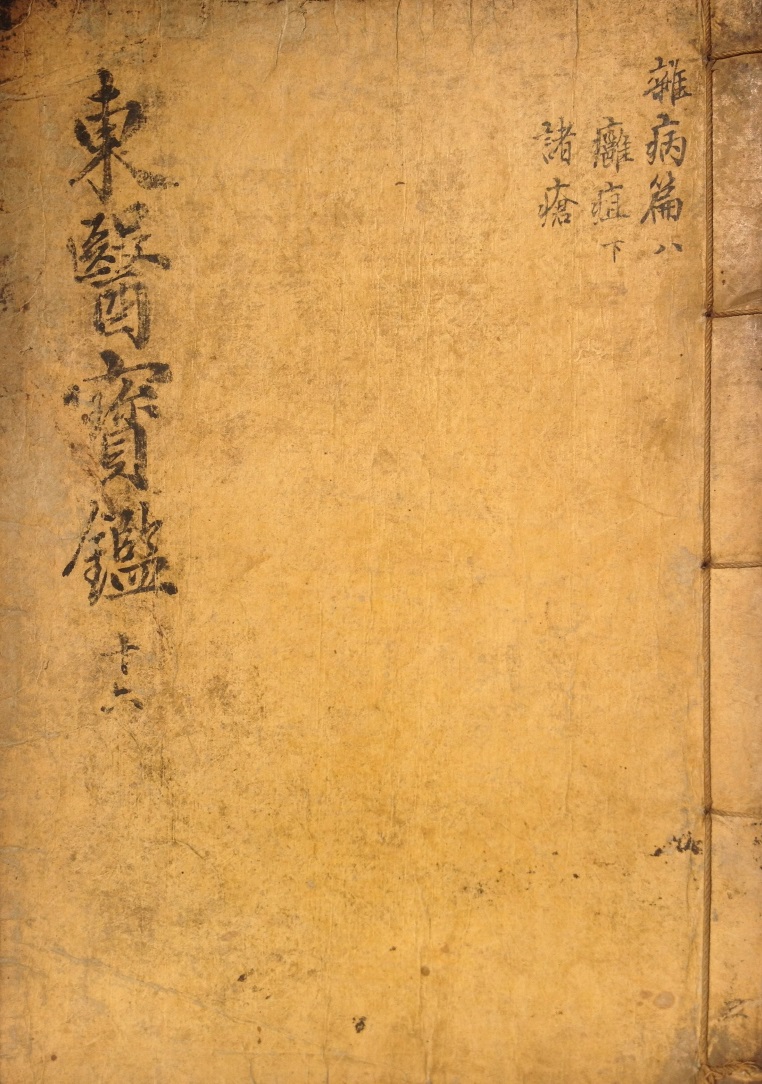
The Donguibogam, the great medical encyclopedia we all know, also stands in the line of the Later Formula school.
Because the Donguibogam is a comprehensive medical work it gathers together the theory of the Later Formula school, but it includes the content of the Shanghanlun — the ancestral bird — as well.
The Four Constitutions school
And last, the pride of our own country: Lee Je-ma’s constitutional medicine.
This one in fact only has about 150 years of history.
He was the man who had the brilliant idea of classifying a person’s constitution and prescribing differently for each.
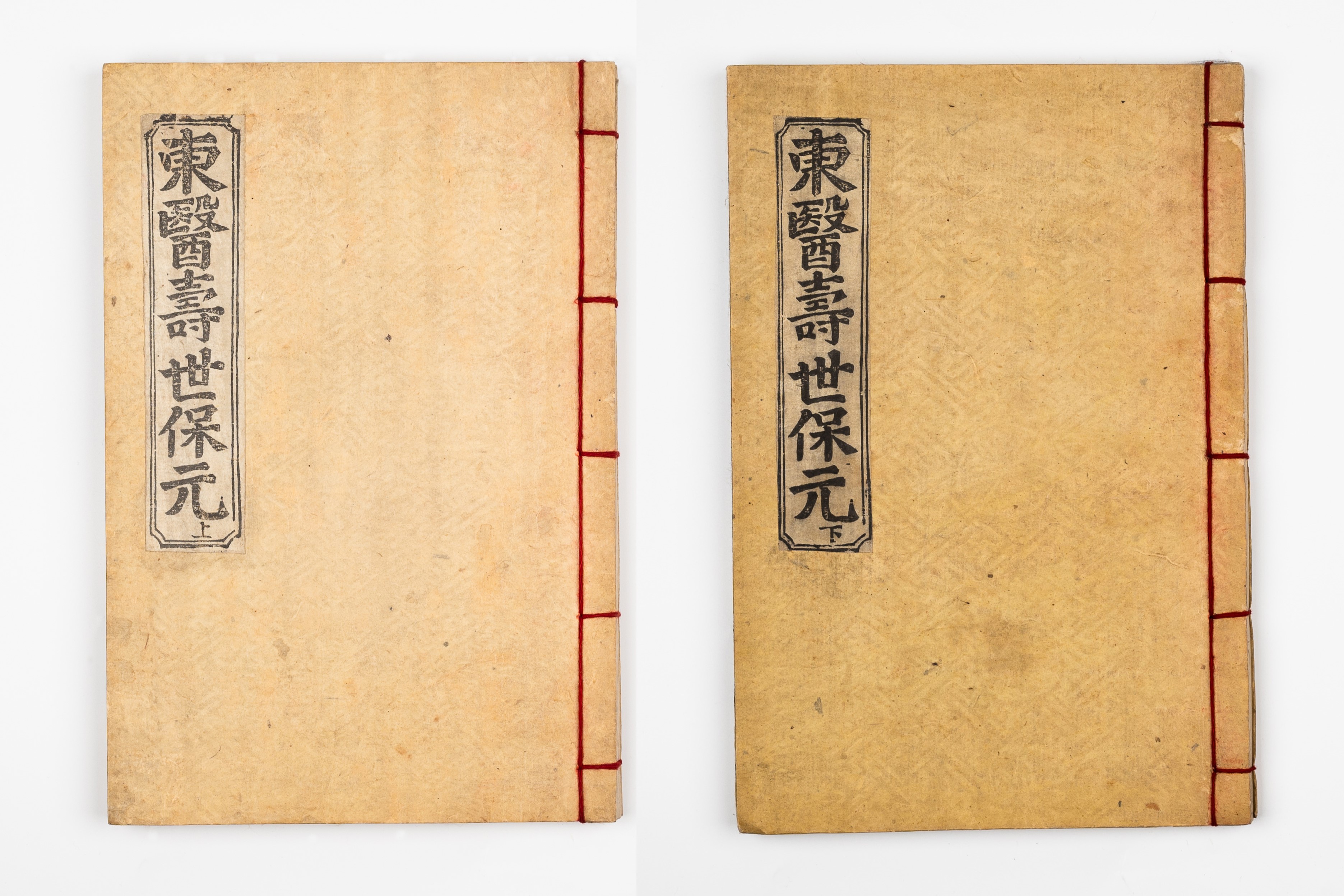
And here is how important the ancestral bird, the Shanghanlun, is: even Lee Je-ma, writing the Dongui Susebowon, refers to the Shanghanlun and its formulas repeatedly.
That is the position the ancestral bird of herbal medicine holds.
So is the Shanghanlun important simply because it is old?
Absolutely not.
Think about 2,000 years ago.
Books — information — were extraordinarily scarce.
There was no paper then. Obviously no printing either.
Books were written out by hand, one character at a time, on bamboo slips or on silk.
And silk was expensive. So mostly it was bamboo slips: you split bamboo and wrote on that.
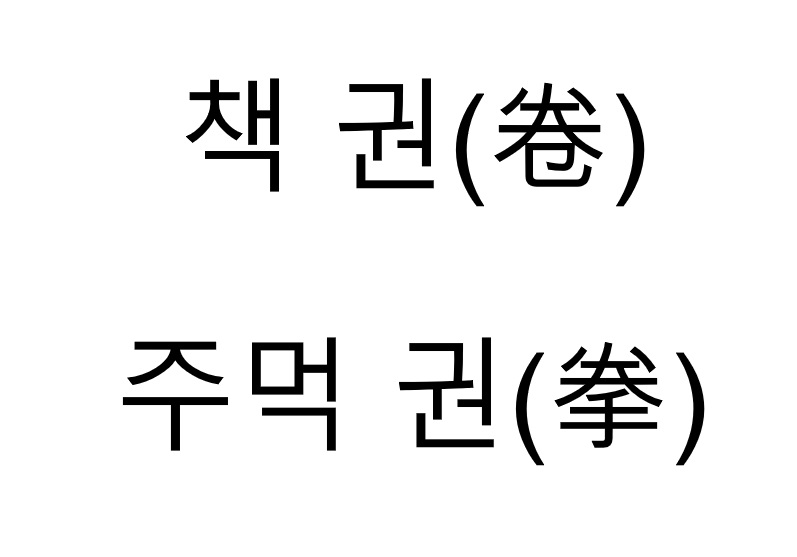
And when you rolled that bamboo up so it could be gripped in one hand, that was one “gwon.” Gwon, as in a volume of a book.
The Chinese character for a volume of a book resembles the character for a fist, doesn’t it?
That is what it means — a book rolled up so it sits in one fist is one volume.
So a word like that is more than 2,000 years old.
At any rate: books, information, were precious in the extreme.
Sun Simiao, who wrote the Qianjin Yaofang in the Tang dynasty, wrote even then that it was a matter for regret that people were each hiding Zhongjing’s essential formulas away and not giving them to the world.
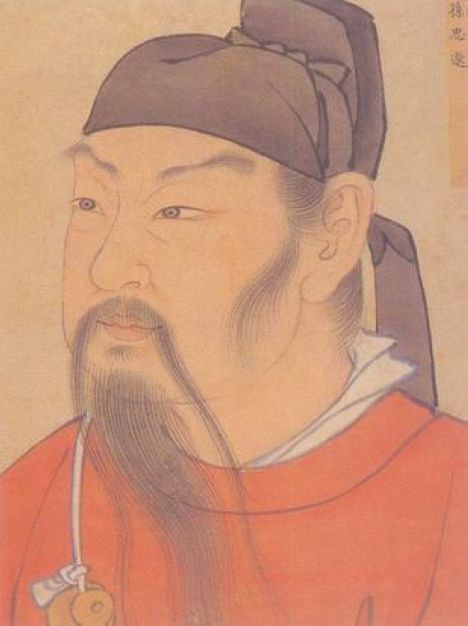
“Zhongjing’s essential formulas” means the content of the Shanghanlun and the Jingui Yaolue.
The author of the Shanghanlun was Zhang Zhongjing.
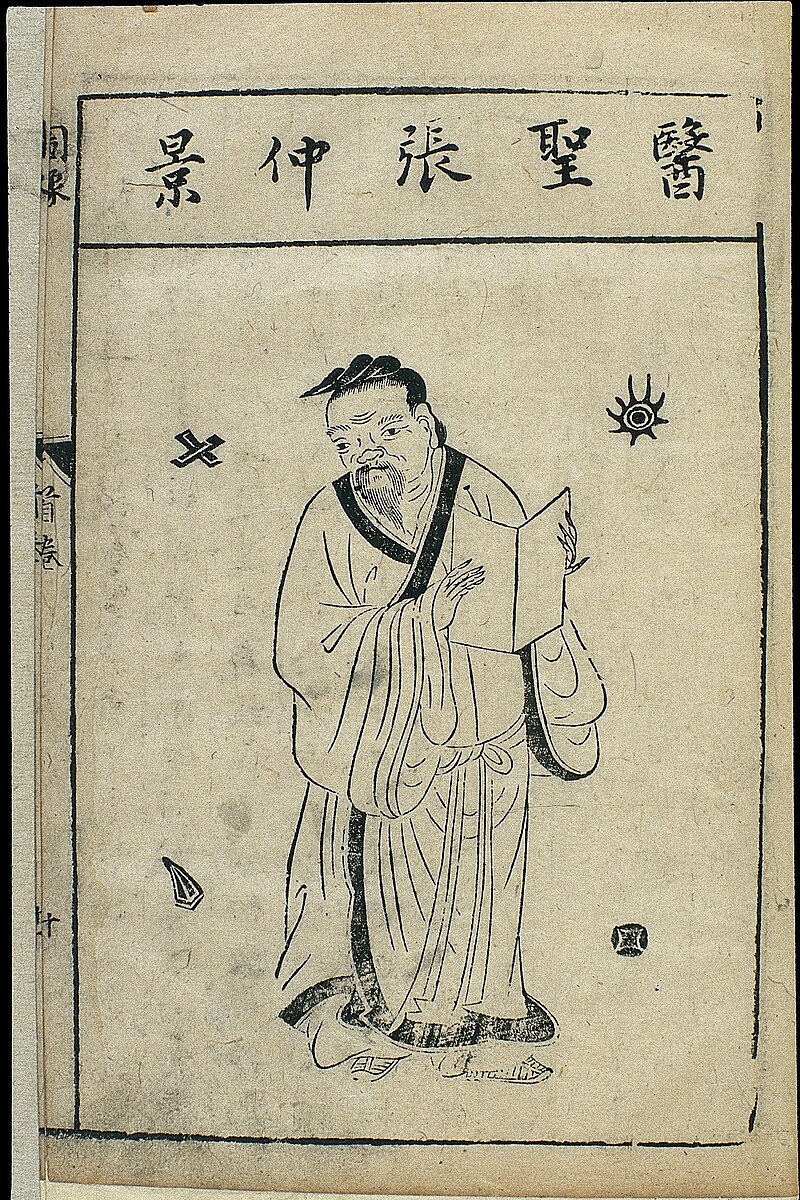
So the formulas of the Shanghanlun were called Zhongjing’s essential formulas — and people were keeping them to themselves and not releasing them. They were that valuable.
Now: books had to be written out by hand one character at a time, and at first they were on bamboo slips, which are hard even to store.
If a formula did not work, it did not get passed down.
People in the past were not fools.
Do you imagine they would go on copying something useless out by hand, character by character, for a thousand years?
Of course not.
And then a thousand years pass, the Later Formula school appears, new theories and new formulas are being produced continuously — and through all of that it survived?
That does not happen unless the formula works.
This has been verified continuously for at least 2,000 years. The ancestral bird of herbal medicine is still alive.
So what is actually in them?
Let us look at an example.
These are called “passages.” The Shanghanlun and the Jingui Yaolue are so important that when they are studied, every sentence is given a number.
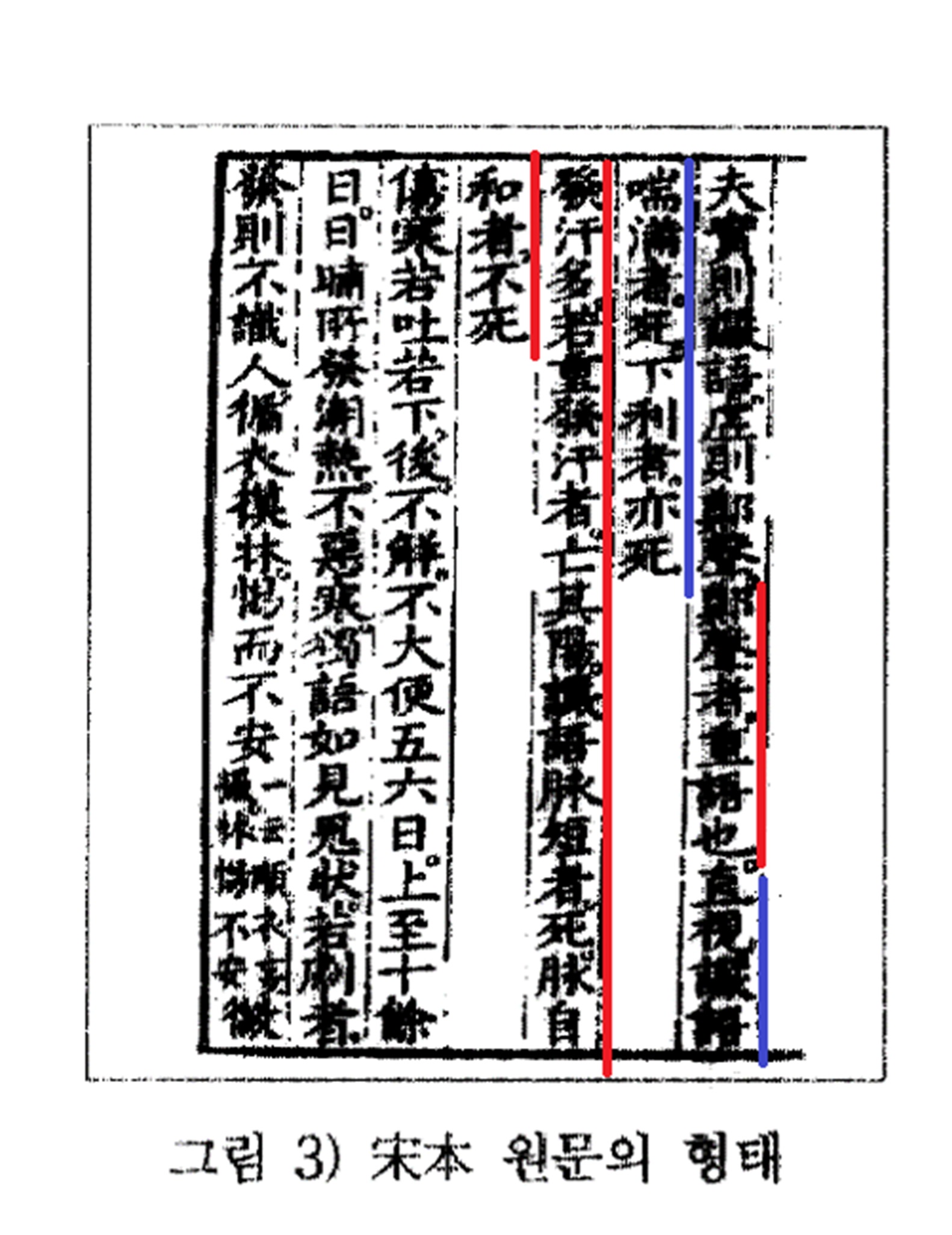
This is what the original text looks like in the Song edition.
Passages 306 and 307 concern Taohuatang — Peach Blossom Decoction.
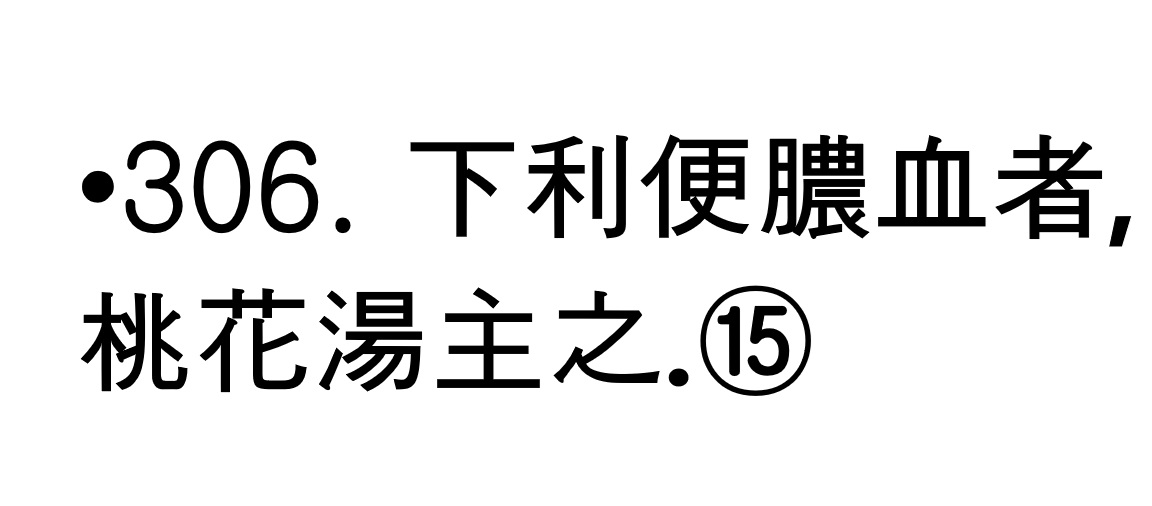
Passage 306. Hari means diarrhea. Byeonnonghyeol — nong is pus, which is to say mucus, and hyeol is blood.
So: one who has diarrhea with mucus and blood in the stool — Taohuatang governs it.
“Governs” here means that this formula takes charge of it, that this formula is the principal treatment.
So: a person with diarrhea and mucus and bloody stool is treated with Taohuatang.
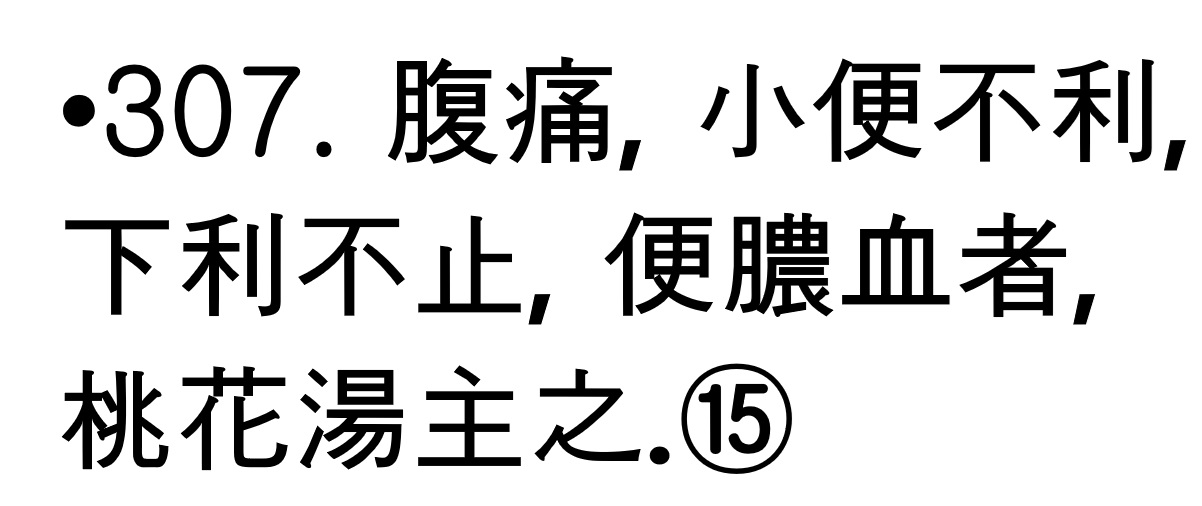
Passage 307: abdominal pain; sobyeon bulli, urine that does not pass freely; hari buji, diarrhea that does not stop; and mucus and blood in the stool. Taohuatang governs it.
In short, one who has abdominal pain, urine that does not come freely, diarrhea that will not stop, and mucus and bloody stool, is treated with Taohuatang.
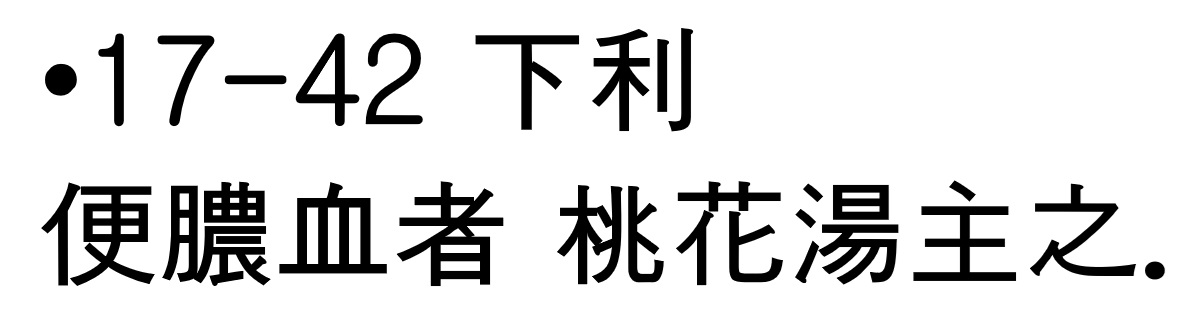
A passage numbered 17-42 like this is not from the Shanghanlun but from the Jingui Yaolue.
Jingui Yaolue passage 17-42 also says: diarrhea, with mucus and blood in the stool — treat with Taohuatang.
Exactly that.
Now look at these.
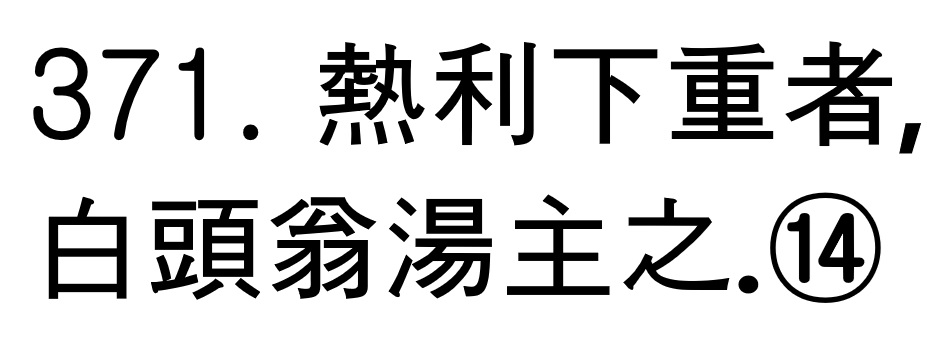
Passage 371. Yeolli hajung: yeol is fever, li is diarrhea, hajung is severe diarrhea, or a heaviness after passing stool.
So: fever with diarrhea and a feeling of incomplete evacuation. In that case Baitouwengtang — Pulsatilla Decoction — is used.
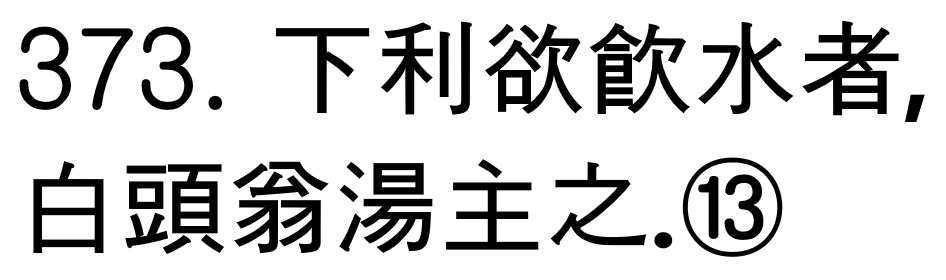
Passage 373. Diarrhea, with yokeumsu, wanting to drink water, which is to say thirst.
Thirst is there because of heat, isn’t it? In that case, treat with Baitouwengtang.
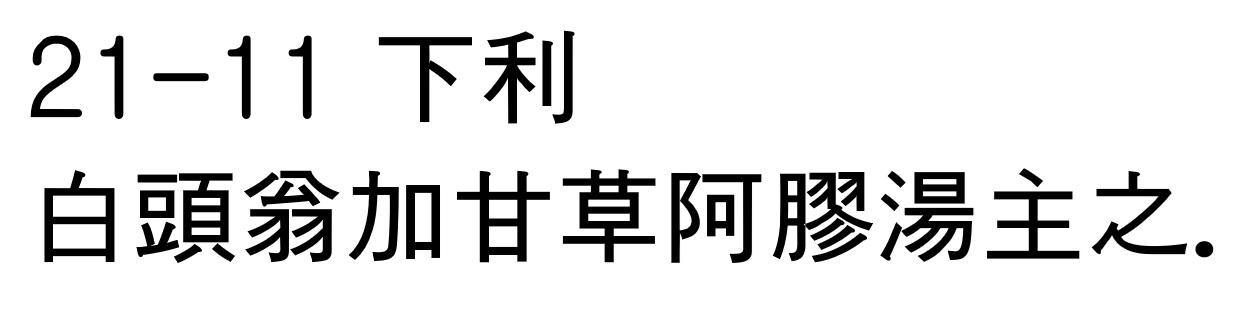
And this one is from the Jingui Yaolue: diarrhea, treat with Baitouweng jia Gancao Ejiao Tang.
When Crohn’s disease or ulcerative colitis worsens, the inflammation produces fever. That is when Baitouwengtang or Baitouweng jia Gancao Ejiao Tang is used.
Someone might ask: aren’t these just formulas for diarrhea? Do these passages anywhere say ulcerative colitis or Crohn’s disease?
But there are far more formulas in the Shanghanlun and the Jingui Yaolue that are simply for diarrhea.
And formulas have been studied without interruption since those two books. A herbal formula is a combination of particular herbs.
The combination used in a formula for ordinary diarrhea and the combination in the herbs named in these passages are not the same.
That line of inquiry has continued right down to the present, and in researching ulcerative colitis and Crohn’s disease I have worked a great deal more of it out.
I wrote a doctoral dissertation and an SCI-indexed paper. That is what they are about.
One more thing, for practitioners
Here are some passages on Dachengqitang — Major Order-the-Qi Decoction.
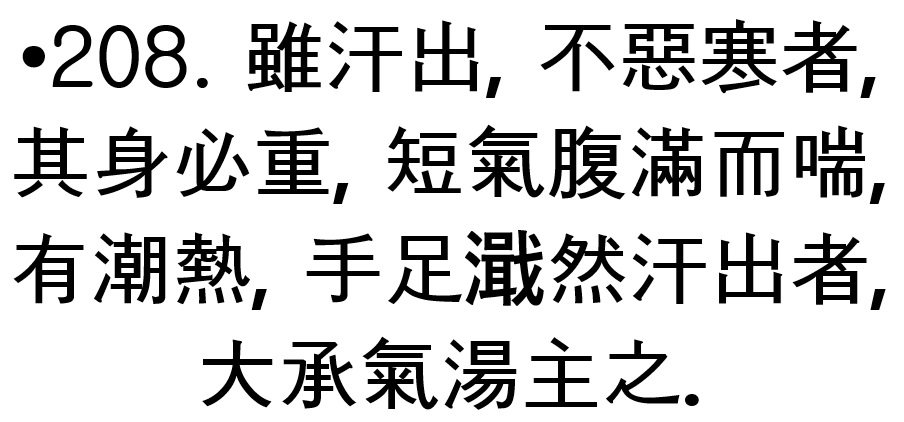
• 208. 雖汗出, 不惡寒者, 其身必重, 短氣腹滿而喘, 有潮熱, 手足濈然汗出者, 大承氣湯主之.
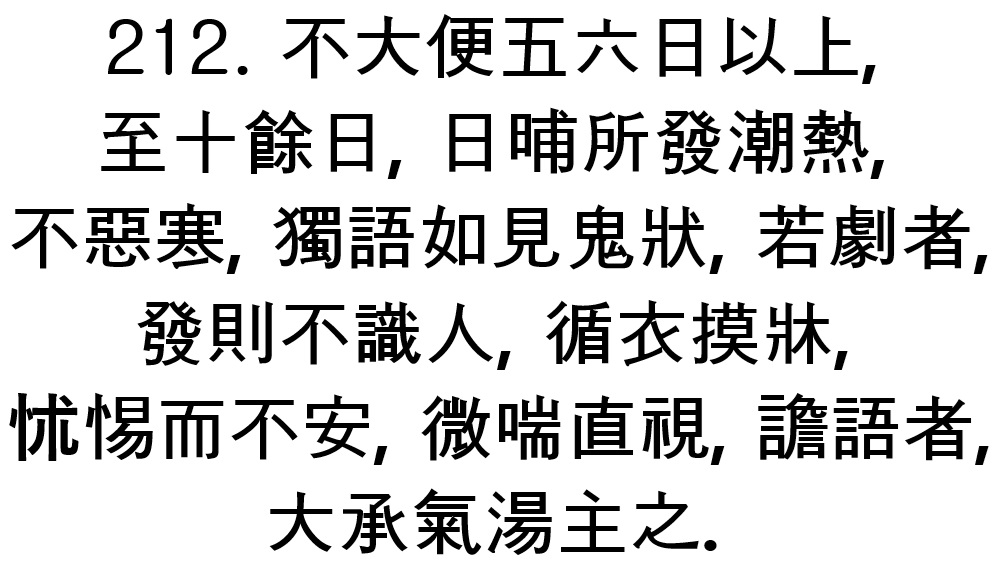
• 212. 不大便五六日以上, 至十餘日, 日晡所發潮熱, 不惡寒, 獨語如見鬼狀, 若劇者, 發則不識人, 循衣摸牀, 怵惕而不安, 微喘直視, 譫語者, 大承氣湯主之.
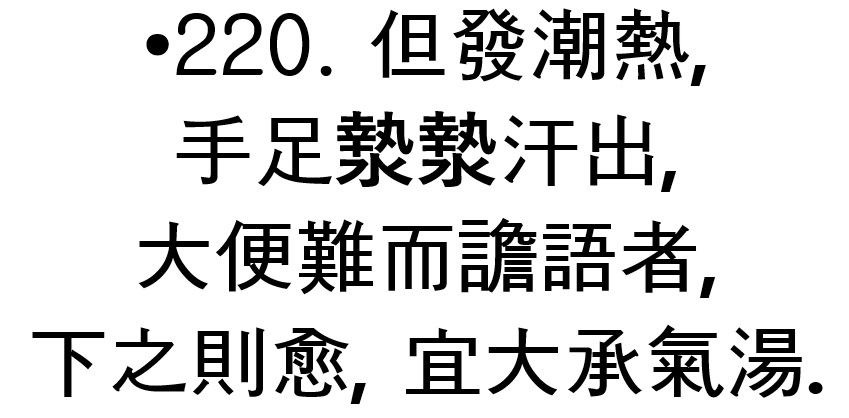
• 220. 但發潮熱, 手足漐漐汗出, 大便難而譫語者, 下之則愈, 宜大承氣湯.
• 241. 六七日不大便, 煩不解, 腹滿痛者, 此有燥屎也, 宜大承氣湯.
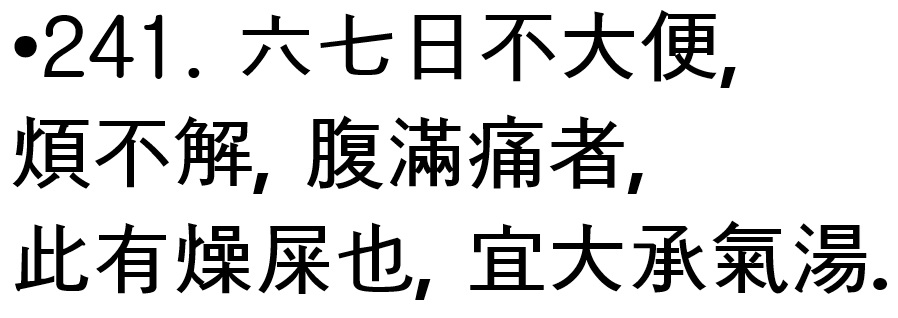
As any practitioner knows, Dachengqitang is a purgative containing rhubarb. A purgative means a drug that produces a bowel movement — a laxative. Take it and you will pass stool.
Read those Shanghanlun passages and they say: if the patient has not passed stool for five or six days or more, with abdominal fullness and tidal fever, use Dachengqitang. If there is tidal fever with difficulty passing stool and delirious speech, purging will cure it, so use Dachengqitang. If after six or seven days without stool the chest is oppressed and the abdomen is full and painful, there is dry stool impacted inside, so use Dachengqitang.
Those general passages you will already know.
But now.
Here is a passage that nobody ever explained properly in a Shanghanlun class when we were students.
Look.
• 321. 自利淸水, 色純靑, 心下必痛, 口乾燥者, 宜大承氣湯.
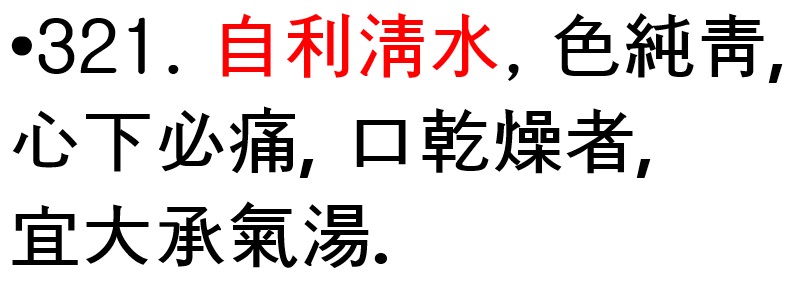
Shanghanlun passage 321. Jari cheongsu: what is being passed is like clear water. Watery diarrhea, running straight through, and the colour completely clear. With pain at the epigastrium and a dry mouth — use Dachengqitang.
• 10-25 下利 不欲食者 有宿食故也 當下之宜大承氣湯.
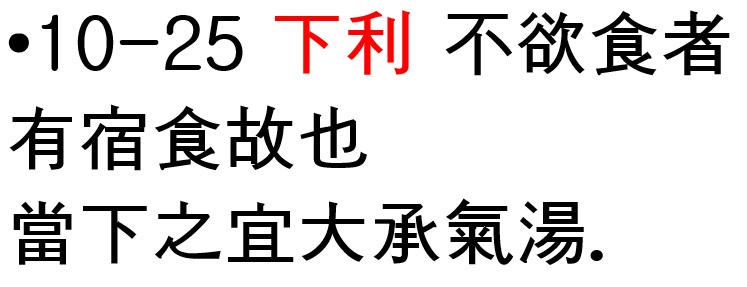
Jingui Yaolue 10-25. One who has diarrhea and no appetite has old residue inside, so use Dachengqitang.
• 17-37 下利 三部脈皆平 按之心下堅者, 宜大承氣湯.
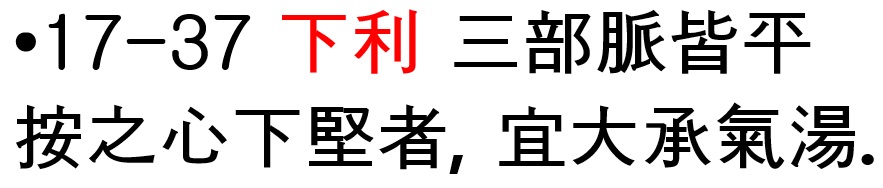
Jingui Yaolue 17-37. Diarrhea, with all three pulse positions even, and hardness felt on pressing the epigastrium — use Dachengqitang.
• 17-38 下利 脈遲而滑者 實也 利未欲止 急下之 宜大承氣湯
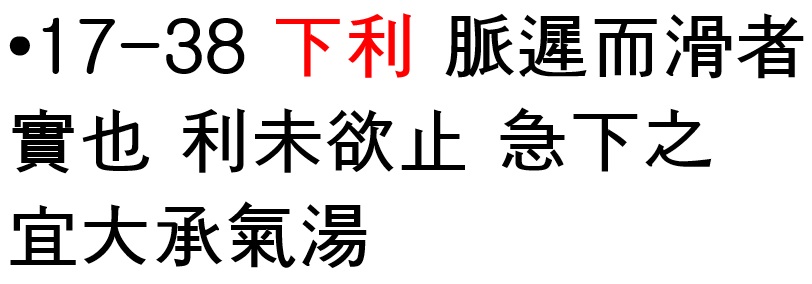
Jingui Yaolue 17-38. Diarrhea with a slow and slippery pulse is an excess condition. When the diarrhea shows no sign of stopping, purge urgently — use Dachengqitang.
• 17-39 下利 脈反滑者 當有所去 下乃愈 宜大承氣湯
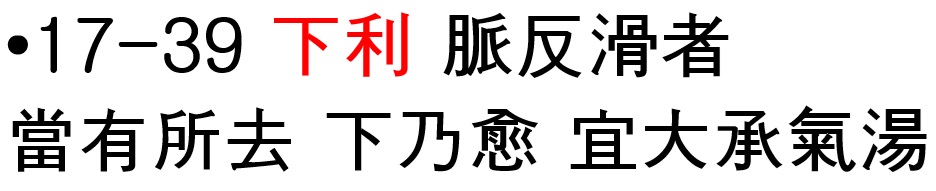
Jingui Yaolue 17-39. In diarrhea, a pulse that is on the contrary slippery means there is something that ought to be removed; purge and it resolves. Use Dachengqitang.
• 17-40 下利已差 至其年月日時復發者 以病不盡故也 當下之 宜大承氣湯
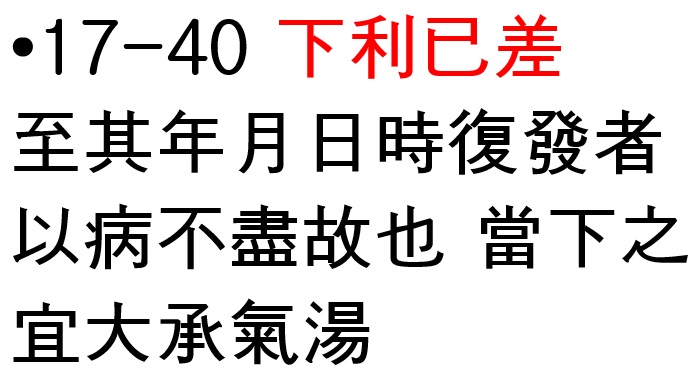
Jingui Yaolue 17-40. Diarrhea that does not improve, and recurs after days or months or years, is because the disease has not been fully treated. It should be purged. Use Dachengqitang.
So there are six passages on Dachengqitang telling you to use it for diarrhea.
Dachengqitang is a drug that causes diarrhea. Use a drug that causes diarrhea in a patient who has diarrhea — has someone lost their mind?
Until now the assumption was that these were old texts, so perhaps there was some error in them.
Nobody could interpret these sentences properly.
But what have I been saying?
That in ulcerative colitis and Crohn’s disease there is a reduced-colonic-function type; that in these patients colonic function is reduced, and in that respect the mechanism is the same as constipation; and that these patients get better when they are purged.
When I first had this thought, I wondered myself whether I had lost my mind. Whether it was not far too dangerous.
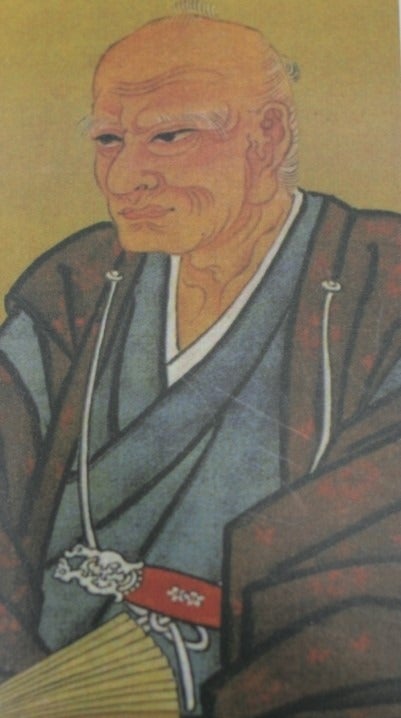
But Yoshimasu Tōdō, the great master of the Shanghanlun in Japan, knew this.
Yoshimasu Tōdō holds a position in Japan comparable to Heo Jun’s here. He spent his whole life studying nothing but the Shanghanlun and the Jingui Yaolue, and in his definition of Dachengqitang he wrote this:
大承氣湯 治腹堅滿, 若下利臭穢, 若燥屎者.
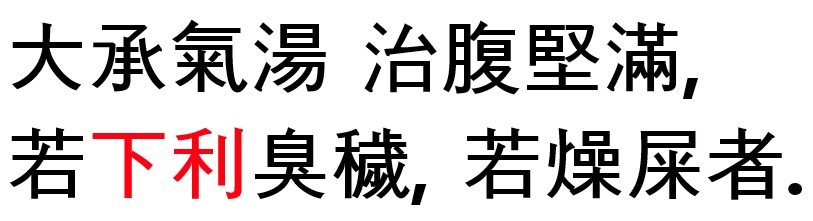
His bangguk is his definition of a formula — its precise indications.
Dachengqitang treats an abdomen that has become hard and full. That is the picture in constipation.
But then: it also treats cases of diarrhea with a foul odour, and cases where there is dry, hardened stool.
That is what he wrote.
So the conclusion is this. Whoever wrote the Shanghanlun 2,000 years ago already knew that a purgative like Dachengqitang is sometimes used in diarrhea. It went on being used through 2,000 years of Korean medicine. And Yoshimasu Tōdō, a physician in Japan, knew it from his own experience.
Taohuatang, Baitouwengtang and Dachengqitang, which I have mentioned here, are all formulas I still use today in treating ulcerative colitis and Crohn’s disease.
I have already dealt with them in my papers.
Of course I do not use them exactly as written. Doses have to be adjusted and the formula modified to fit the patient.
Using Dachengqitang in reduced-colonic-function ulcerative colitis or Crohn’s disease does not mean giving the original formula as it stands at a low dose — that would cause real harm.
This is what I have been researching since 2007. Researching it, applying it to patients, treating them, and writing it up in papers.
Old texts are not detailed, are they?
Written out character by character on bamboo slips and transmitted in secret — there was none of the detailed explanation we expect now.
That only arrives with the Later Formula school and the Donguibogam, once printing had developed enough for annotations and more precise commentary to be added.
Two thousand years ago there was very little of that.
Even so — isn’t it remarkable?
That 2,000 years ago there were already patients with bloody stool and diarrhea, and there were already formulas for treating them.
They did not call the illness ulcerative colitis or Crohn’s disease then, that is all. The patients were already there, and so was the treatment.
I call Korean medicine “the old future.”
It is medicine tailored to the individual. It is the nature-compatible medicine we ought to be moving towards. It treats while maintaining the body’s own homeostasis, and when the right formula is given it benefits the body without any adverse effect at all.
Today’s talk may have been difficult and complicated in places, but I would like you to take away this: there is 2,000 years of accumulated wisdom in Korean medicine, and it is because of that wisdom that ulcerative colitis and Crohn’s disease can be treated today.
That is all for today.
Thank you.
HanStep Korean Medicine Clinic – Inflammatory Bowel Disease Clinic


Leave a Reply